Blog
Extended Essay rubric: the 2027 criteria explained
The Extended Essay is marked out of 30 across five criteria, A to E. This guide explains the rubric in plain words: what each criterion rewards, why Discussion and evaluation is worth the most, why Reflection is marked from a different document, and the slips we see most often in drafts.
By Ejaz Ahmad · 22 October 2026 · 9 min read
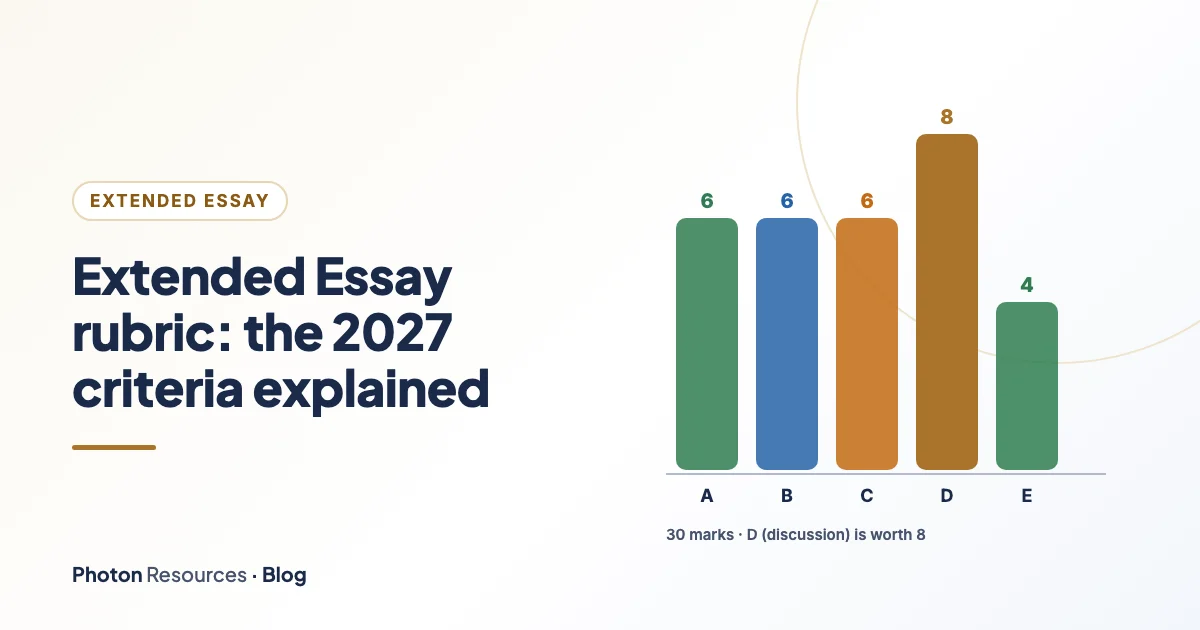
The Extended Essay rubric at a glance
If you are searching for the Extended Essay rubric, the short version is this: five criteria, 30 marks, and one criterion (D) that carries more than any other. The rubric below applies to essays first assessed in 2027, and it is the same for the subject-focused pathway and the interdisciplinary pathway.
A note on sources before we start. The IB publishes the official criteria and descriptors in its Extended Essay guide, and examiners mark from those. I have deliberately not copied them here. What follows is my own paraphrase, built from reading and discussing EE drafts with students at Photon Academy, so treat it as a map and check the official wording on the IB Extended Essay page and with your school.
| Criterion | Marks | In one line |
|---|---|---|
| A. Framework for the essay | 6 | Your question, methods and structure fit together. |
| B. Knowledge and understanding | 6 | Relevant research, accurate terms, concepts really understood. |
| C. Analysis and line of argument | 6 | Evidence is turned into findings, and one thread runs from question to conclusion. |
| D. Discussion and evaluation | 8 | You weigh evidence, sources, methods and rival views. |
| E. Reflection | 4 | Your 500-word statement judges your own decisions and growth. |
IB Extended Essay criteria A to E, in plain words
Criterion A: Framework for the essay (6 marks)
This is the planning that sits behind the essay. A reader should finish your introduction knowing what you are asking, how you will find the answer and why that route makes sense. It rewards a research question that is specific and answerable, methods that suit it, and a structure that helps the reader follow.
- Look for: a question that invites analysis ("to what extent", "how significant") rather than a yes or no.
- Look for: a stated method, such as literature analysis, an experiment, a survey or a case study, with a reason it suits this question.
- Interdisciplinary: the essay must show why both subjects are needed, not just mention two.
The commonest slip is a question so broad that it can only be surveyed. "How has social media affected society?" cannot be answered in 4,000 words. Our Extended Essay topics guide shows how to narrow one.
Criterion B: Knowledge and understanding (6 marks)
B rewards relevant research material, used to build real subject knowledge, with accurate terminology and concepts that are explained and then used. It is about your own words: long quotations do not show that you understand anything.
- Look for: varied, suitable sources (journals, books, data, primary material) rather than only general web pages or study guides.
- Look for: key terms defined once and used consistently. If "culture" and "society" swap places, a reader loses trust.
- Look for: references that match claims. The source must actually say what you say it says.
The slip here is background that fills pages and is never used. If your analysis never touches a paragraph of context, it is not earning B marks.
Criterion C: Analysis and line of argument (6 marks)
C rewards turning research into findings. After each piece of evidence, you explain what it shows and why it matters. Then the question, the findings and the conclusion are joined by one clear thread.
A quick test I give students: read only the first sentence of each paragraph. If those sentences, in order, do not give your argument, the line of argument is not there yet. A topic sentence like "Another factor is education" names a subject; "Education explains more of the gap than income does" makes a claim.
- Look for: evidence followed by interpretation, never evidence left to speak for itself.
- Look for: a conclusion that follows from what the essay has shown, with no new evidence introduced.
- Sciences: data without interpretation or without discussion of uncertainty is a classic loss.
Criterion D: Discussion and evaluation (8 marks)
D is the heaviest criterion, and it asks two things. First, a balanced discussion of what your findings mean, supported by evidence, including rival interpretations. Second, an evaluation of the essay's own research: the quality of your sources, the limits of your methods, and how these affect how far the conclusion can be trusted.
- Look for: the strongest argument against your conclusion, stated fairly, with a reason you still prefer your view.
- Look for: sources appraised: who wrote it, when, with what bias or sample.
- Look for: limitations that are named, explained, and linked to how far you can trust the conclusion.
The typical slip is one evaluation paragraph in the last 200 words, saying "more research is needed". That names nothing. "The sample of 30 students from one school means the finding may not hold for older students" is specific and ties to the claim.
Criterion E: Reflection (4 marks)
E is different from the others. It is marked only from your reflective statement, up to 500 words on the reflection and progress form (RPF), not from the essay. It rewards evaluative reflection with specific examples of decisions you made, what you weighed, what changed, and what you will carry forward.
The slip: a timeline. "First I chose a topic, then I read, then I wrote" describes; it does not evaluate. Build the statement from notes you take straight after each reflection session, and name one decision that changed your essay. More on timing in our Extended Essay word count guide.
Teaching note
Students underweight D and E
In the drafts I see, most students spend their energy on A to C, because description is comfortable. D is the criterion that moves a competent essay to a strong one, and E is the cheapest four marks on the page if you keep notes. Plan both from week one, not the final week.
How the Extended Essay is marked: whole essay, best fit
Criteria A to D are judged on the essay as a whole, not paragraph by paragraph. Marks are whole numbers, awarded by best fit against the level descriptors, so top marks do not require a flawless essay. One more thing worth knowing: examiners are told not to read past the word limit, so an essay that runs over can lose its conclusion, which harms every criterion. See what counts towards the 4,000 words.
| If your draft shows... | It is probably costing you | Quick fix |
|---|---|---|
| A very broad question | A, then C | Add a case, a period or a text to the question. |
| Pages of background | B and C | Cut anything the argument never uses. |
| Evidence quoted, then a new paragraph | C | Add "this shows..." and "this matters because..." after each piece. |
| Evaluation only at the end | D | Weigh each source or method where it first appears. |
| A statement that lists what you did | E | Pick two decisions and explain what you weighed. |
A self-check you can run on your own draft
- Can someone answer my question with one fact or a yes or no? If so, rework it.
- Is each method named, and is the reason for it stated?
- Would an expert call my key terms accurate and consistent?
- Do the first sentences of my paragraphs, in order, give my argument?
- Where, in the body, do I weigh evidence or admit a limit?
- Is the word count under 4,000 by the counting rules, and the statement under 500?
- Are all important points in the main text, not in footnotes or appendices?
The command terms in your research question matter too: "to what extent" and "evaluate" push you towards D-style thinking. Our guide to IB command terms covers how each one changes the answer.
Using the rubric without letting anyone write your essay
The rubric is a tool for self-assessment, not a template to fill. The essay is yours: your supervisor guides but does not write or rewrite it, and any AI output you use must be acknowledged and cited like a source. The IB treats work that is not your own as an academic integrity issue, so check the rules with your school.
The IA and EE Coach works within that line. It gives feedback against the criteria and asks questions, and it never writes any part of your essay. An Extended Essay draft check needs your school's OK first, so ask your coordinator before you use it. For the wider picture, see the Extended Essay hub, the IA and EE guide, and our sibling posts on Extended Essay examples. For background reading on building an argument, the Purdue OWL has a clear page on argumentative essays.
I have taught IB since 2015, and the Extended Essay conversations I enjoy most are the ones where a student reads their own draft against these five criteria and spots the gap before I do. That is the aim: a rubric you can use alone.