Blog
Extended Essay word count: what counts and what doesn't
The Extended Essay is capped at 4,000 words and the reflective statement at 500. This guide sets out what counts towards the limit and what does not, why going over costs you your ending, a word budget per section, a timeline for the three reflection sessions and a safe order for cutting words.
By Ejaz Ahmad · 22 October 2026 · 8 min read
Extended Essay word count: the limits at a glance
The essay has a maximum of 4,000 words. The reflective statement is a separate document, up to 500 words, written on the reflection and progress form (RPF). You are also expected to put in about 40 hours of your own work, with supervision recommended at three to five hours, including three mandatory reflection sessions.
| Item | Limit or figure | Marked under |
|---|---|---|
| The essay | 4,000 words maximum | Criteria A to D (26 marks) |
| Reflective statement | Up to 500 words, on the RPF | Criterion E (4 marks) |
| Your own work time | About 40 hours | Planning, research, writing, reflecting |
| Supervision | Three to five hours, including three reflection sessions | First, interim and final (viva voce) |
These figures follow the 2027 model, and I have put them into my own words. Layout details such as fonts, title page and referencing style come from the IB's guide and your school, so check the IB Extended Essay page and your coordinator as your final authority. For how the marks split, see our Extended Essay rubric explained.
What happens if you go over the 4,000 words?
4,000 is a ceiling, not a target, and it is a hard one: examiners are told not to read or mark anything past the limit. In a normal essay, what sits at the end is your conclusion and much of your evaluation, so an over-length essay can lose its answer and its weighing in one go. That hurts every criterion, not just one.
What counts towards the Extended Essay word count?
This is the question students ask most, so here is the rule in two columns. The limit applies to the essay itself, counting the text a reader reads as argument.
Does the bibliography count in the Extended Essay word count?
No. Citations in any style, and the bibliography or reference list, are outside the 4,000. That is true of the contents page and headers too. Quotations, however, do count, so a long block quote spends your words on someone else's writing. Footnotes and endnotes count if they carry anything beyond a reference, such as an extra explanation.
The Purdue OWL has good, neutral pages on quoting, paraphrasing and summarising if you want to build the habit of using fewer quoted words.
Do tables, diagrams and equations count?
Tables, maps, charts, diagrams, annotated illustrations, equations, formulas and calculations are outside the count. This is a real help in sciences and maths, where data and working take space. Two cautions from teaching experience. First, do not hide argument in a table: the words you use to interpret data are text, and belong in the body. Second, never use appendices, footnotes or endnotes as extra room for argument. Examiners need not read them, so anything important placed there can simply be missed, and that harms your marks.
Rule of thumb
If it is argument, it is in the body
Data, diagrams and working can sit in figures and tables. The point you draw from them must be in the main text, where it is read and counted.
The 500-word reflective statement
The statement sits on the RPF, is up to 500 words, and is marked under criterion E. It is a separate piece of writing with its own limit, so you do not squeeze it out of the 4,000. Confirm with your school how the form is submitted.
Treat it as a document you build over the year. After each reflection session, write a few sentences straight away: what you decided, what you weighed, and what you would change. Later, edit those notes into one statement.
Our rubric post explains what the examiner looks for. In short, specific decisions and honest learning beat a timeline of tasks.
A word budget for a 4,000-word Extended Essay
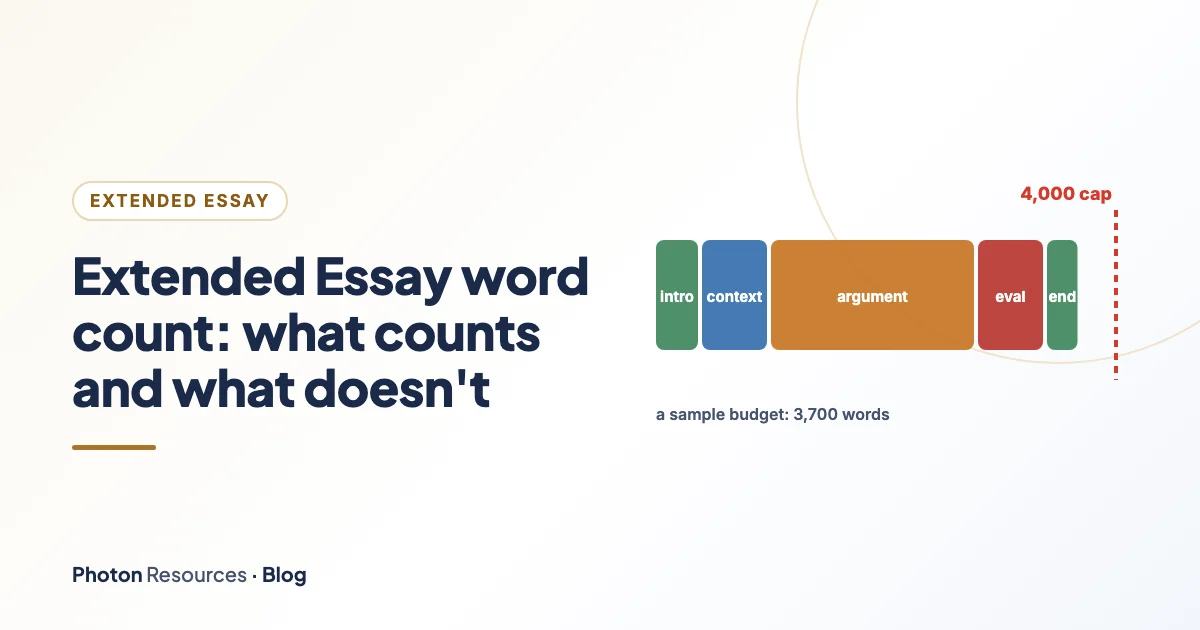
Aim for a total of about 3,700 words in your plan, leaving roughly 300 spare. This is my own teaching template, not an IB rule, and it will shift by subject: a practical science essay spends more on method and data, a literature essay more on close reading.
| Section | Budget (words) | Main job |
|---|---|---|
| Introduction | 300 | Question, significance, method, route. |
| Context, theory and sources | 500 | Only what the argument will use. |
| Method (where relevant) | 400 | Why this method, and enough detail to repeat. |
| Analysis, part one | 800 | Evidence, then what it shows. |
| Analysis, part two | 800 | Rival explanation or second case. |
| Evaluation and discussion | 600 | Sources, methods, limits, effect on the conclusion. |
| Conclusion | 300 | Answer the question; no new evidence. |
| Total | 3,700 | About 300 spare for edits. |
Notice that evaluation shows up in the analysis sections as well. Criterion D is worth 8 marks, so it should never be the last thing squeezed. See our annotated outlines for budgets in Physics, History, Economics and an interdisciplinary essay.
How to cut words without cutting marks
When you are 300 words over, resist trimming the conclusion. Cut in this order and check each step before moving to the next.
- Throat-clearing. "It is important to note that" and "This essay will now discuss" add nothing. They are the easiest 100 words to lose.
- Background the question does not need. If a paragraph never feeds the argument, shorten it to a sentence or drop it.
- Repeated points. Say each claim once, where it does most work, then refer back in a few words.
- Long quotations. Quote only the phrase you analyse, and paraphrase the rest. Quotations count, so fewer quoted words leaves room for your own.
- Wordy phrasing. "Due to the fact that" becomes "because"; "in order to" becomes "to".
- Weaker examples. If three examples make one point, keep the best two.
Do not cut evaluation to make room. If the question itself is too large to fit, go back to the topics and narrowing guide.
At Photon Academy I have taught IB since 2015, and the two rules I repeat most are: keep a running total as you write, and recount after every editing session. A tool that counts the whole document is a trap, because it also counts the bibliography and tables. Ask your coordinator which count your school uses and use that method every time.
Other rules that catch students out
- Your own work. You research and write the essay. Supervisors guide, but do not draft or rewrite it.
- Acknowledge AI. If you use AI output, acknowledge and cite it like any source. Passing it off as your writing is dishonest.
- One subject. The essay is registered under one Diploma subject, even on the interdisciplinary pathway.
- The Diploma threshold. You need at least a D for the Extended Essay to be awarded the Diploma.
The IA and EE Coach can check a draft against these counting rules and the criteria and give feedback. It never writes any part of your essay, and an EE draft check needs your school's OK first. For everything in one place, see the Extended Essay hub and the IA and EE guide. When you are choosing a command term for your question, our command terms guide helps keep the question answerable in 4,000 words.
Next step
Check what each criterion needs
Staying under the limit is only half the job. See what the five criteria reward.