Blog
IB command terms: what each one asks you to do
The first word of an IB question tells you what kind of answer earns the marks. This guide groups the common command terms by type, says what each one wants in plain English, and shows the slip that costs marks, with original examples from maths, physics and chemistry.
By Ejaz Ahmad · 21 October 2026 · 8 min read
What IB command terms are and why they decide your marks
A command term is the verb at the start of a question: state, explain, calculate, evaluate. The IB uses a fixed list, and each word signals a different depth of answer. Two students can know exactly the same physics and score differently, because one wrote a sentence where the question wanted a chain of reasoning, and the other wrote a paragraph where one line was enough.
The IB publishes its own official list and definitions for each subject, and your teacher will have them. This page does not copy those definitions. These are my own paraphrases, written from years of marking practice answers in our classes at Photon Academy, so use them as a working guide and check the official wording in your subject materials.
- Mark count tells you the length. A 1-mark "state" needs one fact. A 4-mark "explain" needs several linked steps.
- The verb tells you the shape. Facts, steps, a number, a sketch or a judgement.
- Over-answering rarely costs marks, but it costs time. Under-answering always costs marks.
The ladder: from recall to judgement
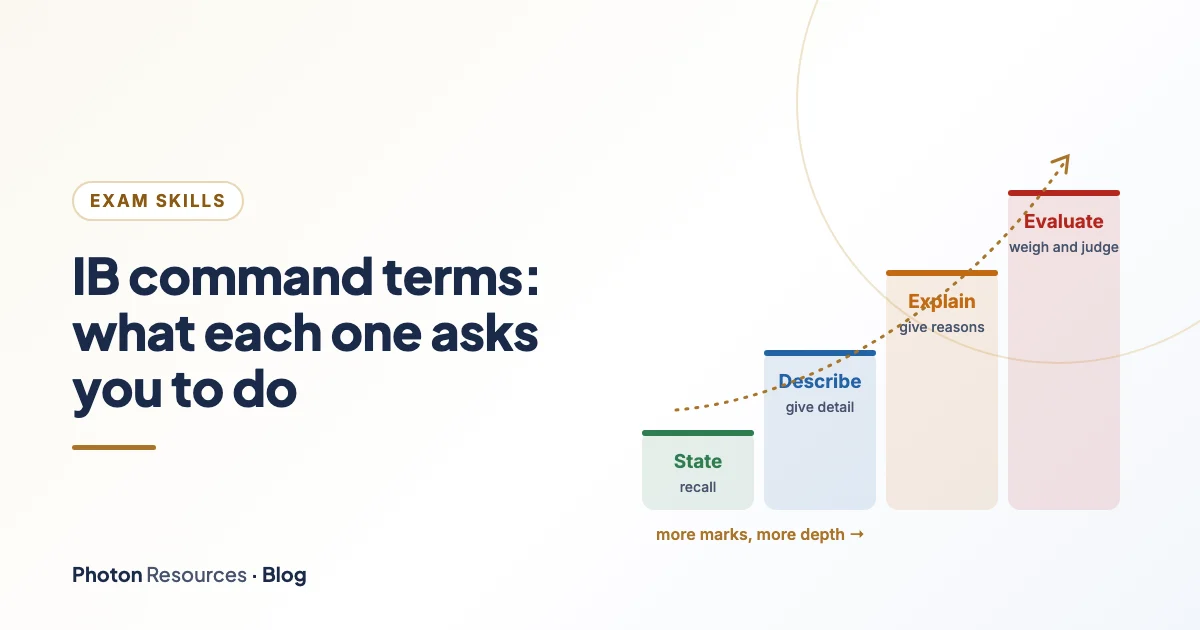
Think of command terms as steps. Low steps ask for recall, middle steps ask you to work something out, and the top steps ask you to weigh things up. The higher the step, the more of your own reasoning the examiner expects to see on the page.
Recall and describe terms: state, define, identify, describe, outline
These ask what is true, not why. Marks come from accurate, specific facts, so precision beats length.
| Term | What it asks, in plain words | Original example, and what earns the marks | Common mistake |
|---|---|---|---|
| State | Give a short fact or value with no working. | "State the SI unit of impulse." Answer: newton second (or kg m s-1). One correct unit earns the mark. | Adding a paragraph. Extra words can contradict the right answer. |
| Define | Give the exact meaning of a term. | "Define a limiting reagent." It must say it is the reactant that runs out first and so sets the amount of product. | Describing an example instead of the meaning, or using the word in its own definition. |
| Identify | Pick out the right item from information given. | "Identify the dependent variable in the experiment." Name it from the question's description. | Listing three variables when one was asked. |
| Describe | Say what something is like or what happens, step by step. | "Describe the trend in the graph." Give direction, then a quoted value or a rate, such as "decreases from 8 to 3 over the first 40 s". | Saying "goes down" with no figures and no shape. |
| Outline | Give the main points briefly, with no fine detail. | "Outline how a titration finds the concentration of an acid." Name the burette, indicator, end point and the calculation, in a line each. | Writing a full method with every detail, which wastes time. |
Explain and reason terms: explain, justify, deduce, suggest, predict
These ask why. The marks are for links: cause, then effect, then consequence. A good habit is to write "because" and "so" in the answer and check each step follows from the last.
| Term | What it asks | Original example, and what earns the marks | Common mistake |
|---|---|---|---|
| Explain | Give the reason, with a cause-and-effect chain. | "Explain why a ball's temperature rises when it is hit." Work is done, kinetic energy of particles increases, so the mean energy rises. | Restating the observation, with no cause. |
| Justify | Give reasons or evidence that back a given answer. | "Justify the choice of a salt bridge." Say what charge would build up without it and what it allows. | Repeating the answer instead of defending it. |
| Deduce | Reach a conclusion from information you are given. | "Deduce the number of neutrons in an isotope with mass number 37 and atomic number 17." 37 − 17 = 20. | Guessing from memory when the data gives the route. |
| Suggest | Offer a sensible idea, often when there is more than one answer. | "Suggest why the measured current is lower than predicted." One plausible cause, tied to the setup, such as internal resistance. | Naming "human error", which earns nothing. |
| Predict | Say what will happen, using knowledge, not working. | "Predict the effect on the period of a pendulum if its length is quadrupled." It doubles. | Giving a direction ("increases") when a size was available. |
Calculate and graph terms: calculate, determine, derive, estimate, show that, sketch, plot
These ask for working. The marks are split between method and the answer, so write the method even when you are sure of the result.
| Term | What it asks | Original example, and what earns the marks | Common mistake |
|---|---|---|---|
| Calculate | Get a numerical answer, with working. | "Calculate the moles in 4.0 g of NaOH." Write n = 4.0 / 40.0 = 0.10 mol: formula, substitution, answer with unit. | Writing only the number, with the unit missing. |
| Determine | Get the answer, but you choose the route (calculation, graph or both). | "Determine the gradient of the line of best fit." Choose two points far apart on the line, not data points. | Using two data points that are not on the line. |
| Derive | Build a result from earlier results, line by line. | "Derive v = u + at from a = (v − u)/t." Rearrange and show each step. | Jumping to the formula. |
| Estimate | Give an approximate value using reasonable assumptions. | "Estimate the mass of air in a classroom." Give a volume, a density, then a product. | Over-precision, or quoting no assumptions. |
| Show that | Reach a result that is already given. | "Show that x = 2 is a root of x³ − 3x − 2 = 0." Substitute and reach 0 on the page. | Starting from the answer, then working backwards. |
| Sketch | Draw the shape with key features marked, not to scale. | "Sketch y = 1/x + 2." Show both asymptotes and the intercepts, labelled. | Forgetting intercepts and asymptotes. |
| Plot | Mark the points accurately on given axes. | "Plot the data." Points to half a square, then a best-fit line if asked. | Joining dots with a ruler. |
Judgement terms: evaluate, discuss, compare, comment
These ask for an opinion that you back with evidence. Marks usually come for two sides plus a conclusion, so a one-sided answer caps out early.
| Term | What it asks | Original example, and what earns the marks | Common mistake |
|---|---|---|---|
| Evaluate | Weigh strengths and limits, then reach a judgement. | "Evaluate the use of a linear model for the data." Say where it fits, where residuals grow, then judge it. | Listing points and never concluding. |
| Discuss | Give a balanced account of different views or factors. | "Discuss the use of platinum in a catalytic converter." A benefit, a cost, then a balance. | One point repeated several ways. |
| Compare | Give similarities and differences, side by side. | "Compare the boiling points of ethanol and ethane." Name both, and give the reason, hydrogen bonding. | Describing each separately without linking them. |
| Comment | Give a short, reasoned remark on a result. | "Comment on the size of the residual." Note it is large and the model is poor there. | Repeating the data without a view. |
"Hence", "hence or otherwise" and "show that" in maths
These three phrases cause more lost marks than any other, because they are instructions about your method, not just your answer.
Hence
"Hence" means use what you just found. A method that ignores the earlier part usually earns no method marks, even if the final answer is right. Example: part (a) gives that x² − 5x + 6 = (x − 2)(x − 3). "Hence solve x² − 5x + 6 = 0" must use the factors, so x = 2 or x = 3.
In our classes, the mark students lose most often on "hence" is a correct answer reached by a route that ignores part (a). The student is capable, but treats the earlier part as a separate question.
Hence or otherwise
This gives you freedom. The earlier part is a hint, not an order. If you can see a quicker route, take it, but make sure it is complete and written out. On the GDC paper, an "otherwise" route can be a graph or a numerical solve, which is covered in our IB Maths GDC guide.
Show that
The answer is given, so the marks are for the route. Start from the left side and reach the right, line by line. Include the line that reaches the target value, then stop. Do not start from the result and work backwards, and do not quote a decimal that only agrees to 3 s.f. when the question gives an exact value. Example: "Show that the area of a sector of radius 6 and angle 1.2 rad is 21.6." Write ½ × 6² × 1.2 = 21.6, and stop.
Quick rule
Show that: write one more line than you think you need
The examiner cannot award marks for a step they cannot see. If the jump between two lines surprises you, add the line in between.
How command terms set the expected length and marks
The mark count and the command term together tell you how much to write. This is my own rule of thumb, not an IB rule: aim for about one distinct point per mark, and write the point in the form the term asks for.
| Pattern | What to write |
|---|---|
| State, 1 mark | One short fact, one line. |
| Describe, 2 marks | Two specifics with a figure or feature each. |
| Explain, 3 marks | A chain of three linked steps, each with "because" or "so". |
| Calculate, 3 marks | Formula, substitution, answer with unit. |
| Evaluate, 4+ marks | A strength, a limit, and a conclusion that picks a side. |
For practice at all four difficulty levels, work through the questions in the free practice topics, or see which verbs your subject uses most in the past-paper analysis. If you want a sister-site view on top marks, see tips for a grade 7 in IB.
Teaching IB Physics and Maths since 2015, I see the same pattern every year: students who read the command term first write shorter, cleaner answers than students who read the whole stem and then start writing. In explain questions, the commonest gap is a missing middle step, where the student states the cause and the result but skips the link between them.
Two habits help. Underline the command term before you read the rest of the question. Then, after you answer, glance back and check that your answer's shape matches the term: a number for "calculate", a reasoned chain for "explain", a verdict for "evaluate".
Practise it
Train on the verbs, not just the content
Photon practice questions are labelled by level, so you can see how the same command term shifts from Foundation to Challenge. Try the free topics first.