Blog
How IB grade boundaries work and what a 7 really takes
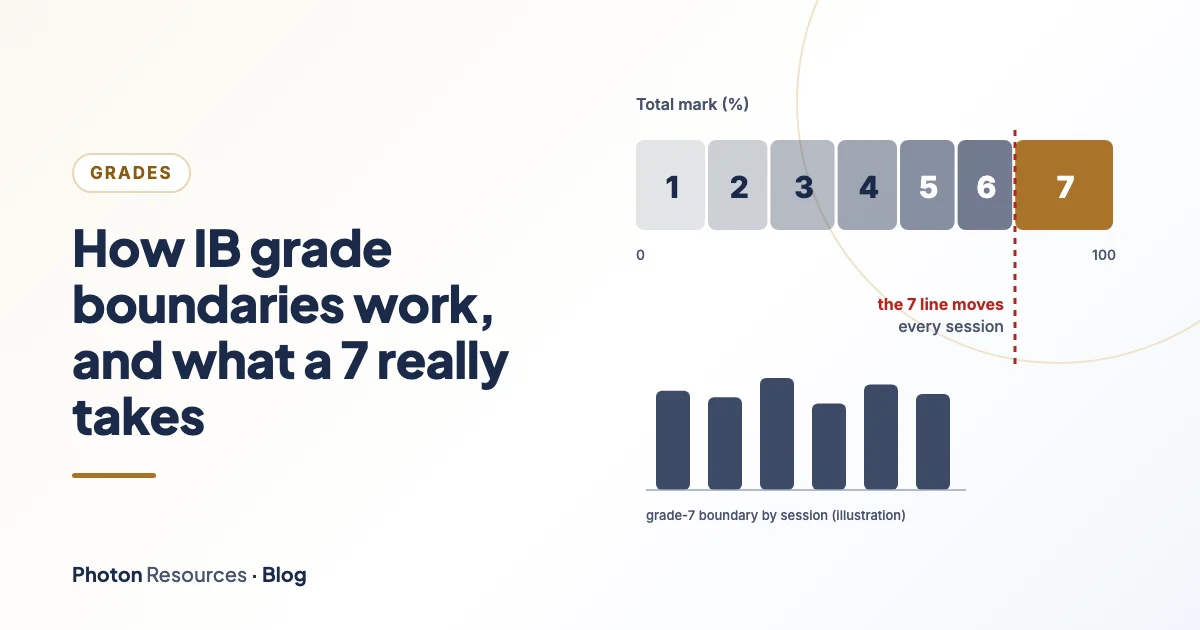
A grade 7 is not a fixed percentage. It is a line drawn after the marking is done, and it moves. Here is how marks become a grade, what the real numbers show, and how to use them to set a target you can actually work towards.
By Ejaz Ahmad · 21 October 2026 · 9 min read
- Marks to grade
- Real 7 boundaries
- Core points
- Target marks
Every year students ask the same question: "what percentage do I need for a 7?" The honest answer is "it depends on the session, and nobody knows until after the exams". That sounds unhelpful, but the boundaries are far more predictable than they feel, and they are useful for planning once you know what they are and are not.
From raw marks to a grade from 1 to 7
Each subject is built from components: written papers and an internal assessment, each marked out of its own total. The path to your grade has four steps.
- Raw marksEach paper and the internal assessment is marked against its markscheme, giving a mark out of that component's total.
- Component percentagesEach raw mark becomes a percentage of the marks available on that component.
- Weighted totalThe percentages are combined using the subject's weightings, so a long paper counts for more than a short one. You end with one overall percentage for the subject.
- Grade 1 to 7The overall percentage is placed on the scale using that session's grade boundaries.
The first three steps are arithmetic you can do yourself. The last step is the one you cannot, because the boundaries do not exist until the exams are marked. The IB describes boundaries as the ranges that the combined component marks are divided into along the 1 to 7 scale (see the IB's page on assessment and passing criteria).
Who sets the boundaries, and when
Boundaries are set after each exam session, in a process called grade award. Senior examiners look at the evidence from that session: how the papers performed, samples of real scripts at the borderline, statistical comparisons with earlier years, and the expectations of experienced teachers. The IB says that the boundaries for grades 4, 7 and 3 are set by judgement, in that order, and the rest are worked out arithmetically between them.
The aim is to keep the standard of a grade the same from one session to the next, not to give out a fixed share of 7s. If a paper turns out harder than usual, the boundary comes down. If it was kinder, the boundary rises. Larger courses also have several timezones, each with its own paper, so each timezone gets its own set of boundaries.
What the real numbers show
Here are the grade 7 boundaries (percentage of total marks) for three courses across the last two May sessions, taken from our IB grade boundaries data.
| Course | May 2025 TZ1 | TZ2 | TZ3 | May 2026 TZ1 | TZ2 | TZ3 |
|---|---|---|---|---|---|---|
| Physics HL | 67% | 68% | 71% | 73% | 74% | 72% |
| Chemistry HL | 74% | 74% | 75% | 75% | 79% | 73% |
| Maths AI SL | 70% | 66% | 77% | 79% | 71% | 76% |
Three things stand out. Within one session the same course can differ a lot by timezone: for Maths AI SL in May 2025 the 7 was 66% in one timezone and 77% in another, an 11-point gap. Between years the number can shift too: Physics HL's 7 was 67% in May 2025 TZ1 and 73% in May 2026 TZ1. And in a stable course such as Chemistry HL the 7 stayed in a narrow band of 73% to 79% across these sittings.
The chart adds the November 2025 sittings (TZ1 and TZ3, as published) for Physics HL and Chemistry HL. In every sitting the 7 sat between 67% and 79% of the total marks. Physics HL's 7 rose from the high 60s to the low 70s over the period, while Chemistry HL moved less but showed one outlier at 79% (May 2026 TZ2). The new Physics and Chemistry courses were first examined in May 2025, so the history is short and you should not read a trend into three sessions.
Read the numbers carefully
These are overall percentages, not paper scores
The boundaries here are percentages of the total marks for the whole subject, with all components combined. A 7 at 73% does not mean 73% on each paper. You can score 60% on one paper and 85% on another and land in the same place.
I have taught the IB since 2015, and at Photon Academy, where we run an IB centre in Singapore, the same pattern repeats every year. Students who quote last year's boundary as if it were a rule are almost always the ones surprised in July. The students who treat it as a range come out calmer, and usually better prepared.
Why boundaries move
- Paper difficulty. The examiners cannot write two papers of exactly equal difficulty. When one is harder, marks fall and the boundary falls with them.
- Timezones. Each timezone has its own papers, so it gets its own boundaries. The gap in the table above is that effect.
- Course changes. In the first years of a new course, the papers and the way students prepare are both still settling.
- Cohort and markscheme details. Small differences in how a question was answered across the world can move a boundary by a mark or two.
The core points and the total out of 45
Six subjects at up to 7 each give 42 points. The Theory of Knowledge grade and the Extended Essay grade, each from A to E, combine in a matrix worth up to 3 bonus points, which makes 45 the maximum. An E in either is a failing condition, whatever the total. The diploma needs at least 24 points plus the other conditions, such as no grade 1 and CAS completed. Rather than learn the matrix, type your own numbers into the IB grade calculator, which checks every pass condition and says which one fails.
Turning a boundary into a target mark per paper
You cannot know next May's boundary, but you can plan against a range. Here is a method that works.
- Pick a planning boundaryLook at the 7 for your course on the boundaries page and take the top of the recent range, not the bottom. If recent 7s were between 67% and 74%, plan for 75%.
- Add a bufferAim 5 percentage points above the planning boundary. That is your target overall percentage.
- Split it by componentUse your subject's weightings to set a target for each paper and the internal assessment. Your internal assessment mark is known early, so subtract it first and see what the papers must deliver.
- Check it against your practice papersMark a timed past paper strictly and compare it with the target for that paper.
A worked example with made-up weightings: say a course is two papers at 40% each and an internal assessment at 20%, and your planning boundary is 75%, so your target is 80%. If your internal assessment is worth 85% (17 of the 20 weighted points), the two papers must supply 63 of the 80 weighted points, an average of 78.75% across them. Now each paper has a clear target. If Paper 1 is your weaker one at 72%, Paper 2 has to reach about 85%, and you can see where to put your revision hours.
Why you should aim above the boundary
In my classes, the mark students lose most often is not on the hardest question. It is on the last part of a question they half-knew, where one missing step or unit costs the mark. Those marks are worth the same as any other, and they are what separates a 6 from a 7 when the boundary lands a point or two higher than hoped.
Because the boundary is only known afterwards, a mark right on the line is a gamble on the session. Aim above it for three reasons. First, a timezone 4 to 5 points harder than you expected would take a borderline paper from a 7 to a 6. Second, exam-day marks fall short of practice marks because of nerves and unfamiliar questions, so target a buffer. Third, practice papers are marked by you, and most of us are kinder to ourselves than an examiner is. Strict marking against a markscheme, with no method marks for half-written lines, gives a truer picture. For more on setting targets and review habits, the IB revision plan, topic by topic and level by level shows how to work towards a number like this across twelve weeks.
For a wider set of habits from the teaching side, see tips for getting a grade 7 on our sister site. To see which topics carry the marks in your course, start with the IB past paper analysis.
Practise it
Close the gap with exam-level questions
Targets only help if you can reach them. The Photon Library has practice questions at four levels, Foundation to Challenge, and the first two topics of every course are free.
Keep reading