Blog
An IB revision plan that works topic by topic, level by level
Most revision fails because it is either all reading or all full papers. This plan sits between the two: find your weak topics, practise each one in four rising levels, track your errors, then move to full papers. It is laid out week by week for the twelve weeks before the May 2027 exams.
By Ejaz Ahmad · 21 October 2026 · 10 min read
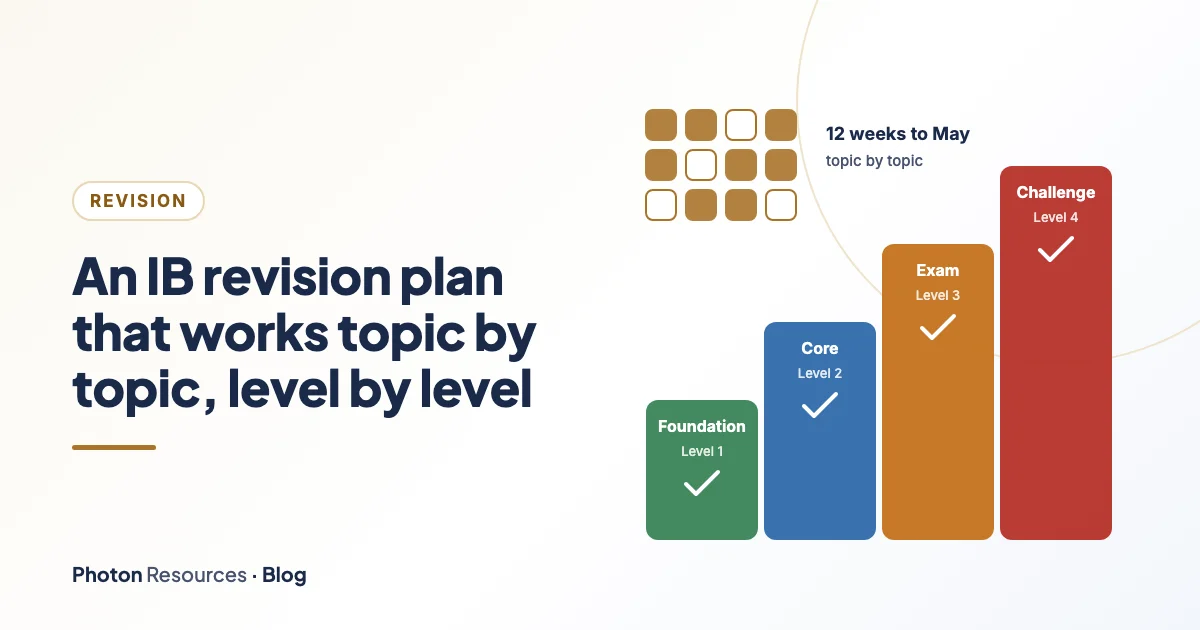
- 12 weeks
- 4 levels
- Paper 1 and 2
- Error log
A student who arrives at the last twelve weeks with six topics they know well and six they avoid has a plan problem, not a motivation problem. The topics they avoid cost the most marks, and they are exactly the ones that never get practised. The method below is built to fix that, topic by topic, using a simple idea: practise each topic in steps of rising difficulty, and only move up when the lower step is secure.
Why practise by level instead of by paper
A full past paper mixes everything. If you score 55%, you do not know whether the problem is one weak topic, a shaky method, or running out of time. A paper is a good test but a poor teacher. Practising one topic at a time, in four steps, tells you precisely where the difficulty starts.
- FoundationOne idea at a time with the method clear. This is where a topic you have forgotten comes back.
- CoreStandard one- and two-step questions, like the start of a paper. You should be fluent here before moving on.
- ExamMulti-part questions that mix the ideas in the topic, in the style and length of real papers.
- ChallengeThe hardest questions, with unfamiliar set-ups and longer reasoning. This is where a 6 becomes a 7.
Do each level for both papers where your course has two: in Maths AA, Paper 1 has no calculator and Paper 2 allows one, so a method you can do by hand needs separate practice from one you do on the calculator. In Physics and Chemistry the split is between multiple-choice and data questions and the longer written ones. The papers rarely test the same habits.
Step 1: diagnose your weak topics
In my classes at Photon Academy, students nearly always start revision with the topic they like best. It feels productive and costs the most time for the least gain. Instead, spend week 1 finding the weak spots.
- Look at what the papers actually test. The IB past paper analysis shows how often each topic appears and how many marks it carries. Your course page has the detail, for example Maths AA HL, Physics HL and Chemistry HL. A topic worth many marks that you avoid goes at the top of the list. You can read how we build those pages in how we analyse papers.
- Take a short quiz per topic, closed-book. Ten minutes of Core-level questions on each topic, marked strictly, is enough to separate "know it" from "think I know it".
- Rank topics by gap times weight. A weak topic worth 10% of the marks outranks a weak topic worth 2%.
The 12-week plan
This assumes you start twelve weeks before your first paper. Count back from your own timetable, which your school will give you. Adjust it if you have less time by trimming weeks 3 to 8, not by skipping the diagnosis.
| Weeks | Focus | What you do each week |
|---|---|---|
| 1 to 2 | Diagnose | Closed-book quiz per topic. Rank topics by gap and weight. Start your error log. Foundation questions on the three weakest topics. |
| 3 to 5 | Foundation and Core | Two to three weak topics per week at Foundation, then Core, both papers. Move up at about 80%. Revisit last week's topics for ten minutes. |
| 6 to 8 | Exam level | Exam-level sets on every topic, timed. One strong topic per week at Challenge so you stay sharp. Review the error log every Sunday. |
| 9 to 11 | Full papers and Challenge | One full timed paper per week per course, then two. Challenge sets on topics where the paper exposed a gap. Move to predicted papers once you have done recent past papers. |
| 12 | Light review | Error log, cheatsheets and formula pages only. No new topics. Rest before the first paper. |
When to move up a level
Move up when you score about 80% on a set at your current level, done in one sitting without notes. Below that, stay and look at why you lost the marks. If most were careless, repeat the set a few days later. If most were a method you did not know, go back to the notes or the cheatsheets before trying again. Treat 80% as a guide, not a law: for a topic you will certainly meet in a long question, push closer to 90% before Challenge.
Keep an error log
An error log is a simple table with four columns: the question, what went wrong, the cause, and the fix. Sort the causes into a few kinds: did not know the idea, knew it but misapplied it, arithmetic or unit slip, misread the question, ran out of time. After two weeks the pattern is clear and usually surprising.
In our classes, the mark students lose most often is one they could have won: a sign error, a missing unit, a calculator answer left unrounded. Those do not need more content. They need a checking routine, and the log shows you which one to build. Review it weekly and re-attempt old errors cold a week later. If you can do them again, they are fixed.
Spaced retrieval and interleaving
Two habits do most of the work, and the research behind them is solid. A large review of ten learning techniques by Dunlosky and colleagues (2013) rated practice testing and distributed practice highest for usefulness, while rereading and highlighting, which many students rely on, rated low. In plain terms: close the notes and try the question, and come back to a topic after a gap, not in one block.
- Retrieval. Start each session by attempting five questions from last week, closed-book, before touching anything new.
- Spacing. The plan above revisits topics at one day, one week and about three weeks. A topic you did in week 3 appears again in weeks 4, 6 and 9.
- Interleaving. From week 6, mix topics inside a set instead of doing ten of the same kind. It feels harder and slower, but it trains you to spot which method a question needs, which the exam does not tell you.
The Learning Scientists publish free, readable summaries of these strategies if you want to go deeper.
When to switch to full papers and predicted papers
Do full papers when most of your topics are secure at Exam level, around week 9. Before that, a full paper is mostly a measure of what you have not covered. Use them to do three things: practise timing, find the topics that still leak marks, and check progress against your target mark per paper from the grade boundaries guide. Mark each one strictly with the markscheme, and send every lost mark to the error log.
Predicted papers belong at the end. They are most useful once you have exhausted released papers, because they test the same skills on fresh questions. For how the two compare with school mock exams, see predicted papers versus marked mock exams. For wider habits beyond revision, read tips for getting a grade 7.
How the Photon Library maps to this plan
The Photon Library is organised on exactly this scale. Every topic in web practice has the four levels, Foundation to Challenge, for each paper, with step-by-step markschemes, tap-to-score marks and saved progress, so your 80% rule is easy to track. The first two topics of every course are free, so you can try the method before buying. See what the full library includes, with notes and cheatsheets for each topic.
Start this week
Your first three actions
Take a ten-minute closed-book quiz on each topic. Rank the results by marks at stake. Start an error log with your first strict-marked set.
Practise it
Run week 1 on the free topics
Try the four levels on two free topics in your course, for Paper 1 and Paper 2, and see where your 80% line falls.
Keep reading