Blog
IB Chemistry Paper 1A and 1B: how the papers work and how to prepare
From the 2025 first-assessment course, IB Chemistry Paper 1 is split into 1A (multiple choice) and 1B (data-based questions), and Paper 2 carries the short-answer and extended-response work. Here is how the pieces fit at SL and HL, and what to practise for each.
By Ejaz Ahmad · 21 October 2026 · 8 min read
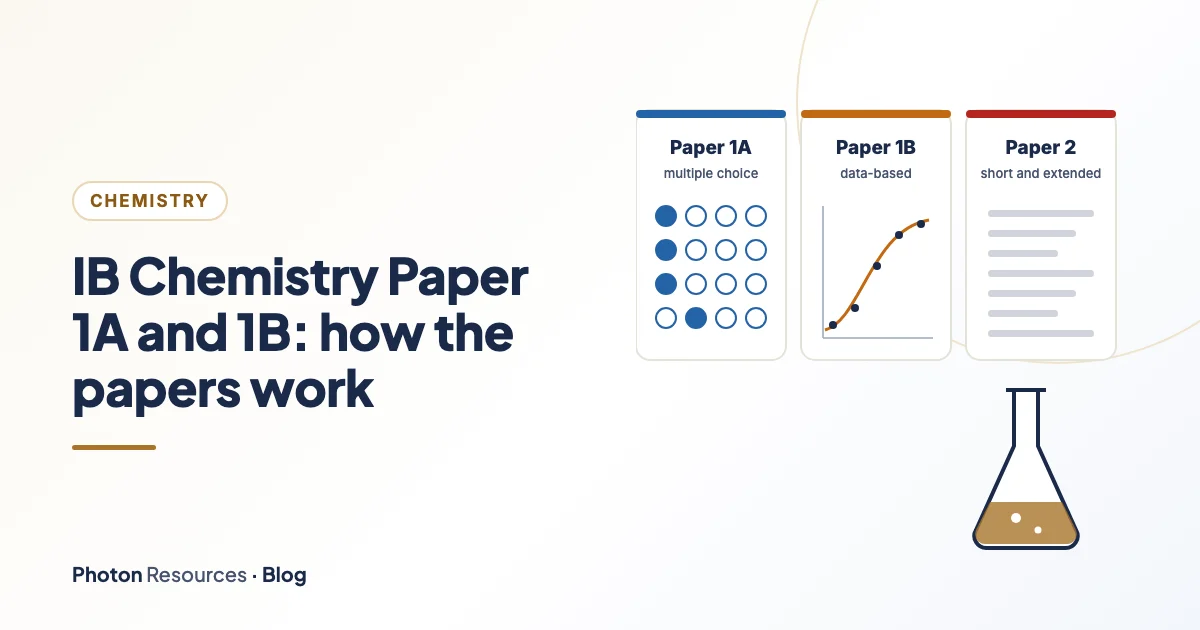
- Paper 1A
- Paper 1B
- Paper 2
- SL and HL
Students who sat the older course remember a Paper 1 that was all multiple choice. That is no longer true. In the course first examined in 2025, Paper 1 has two parts that you sit in one continuous session, and the second part tests something different from the first. If you prepare for both in the same way, you will lose marks on the part you did not train for.
The exam structure: Paper 1A, Paper 1B and Paper 2
The figures below are the published assessment outline for the 2025 course (summarised from the IB's course outline as reproduced by revision providers, and consistent with the specimen papers). The two external papers together make up 80% of the grade and the internal investigation makes up the other 20%.
| Component | SL | HL | Weighting |
|---|---|---|---|
| Paper 1 (1A and 1B) | 1 h 30, 55 marks | 2 h, 75 marks | 36% |
| Paper 1A: multiple choice | 30 questions | 40 questions | inside Paper 1 |
| Paper 1B: data-based | the remaining marks (25) | the remaining marks (35) | inside Paper 1 |
| Paper 2 | 1 h 30, 50 marks | 2 h 30, 90 marks | 44% |
| Internal assessment | Scientific investigation | 20% | |
If your school has changed anything for your cohort, follow your school's guidance. We have only listed figures we could confirm from the published outline; for anything else, such as how marks are split inside Paper 2, read the IB's subject guide through your teacher.
How SL and HL differ on these papers
The structure is the same at both levels. What changes is length and depth. HL has more multiple-choice questions, a longer Paper 2 and extra content from the HL-only topics. The pace is close, though: working it out, SL Paper 1 gives you about 1.6 minutes per mark and HL gives about the same. The practical lesson is that your time per mark does not grow when you move to HL, so speed on routine steps matters just as much.
Paper 1A multiple choice strategy
Multiple choice in this course is not recall of definitions. The questions are built so that a plausible wrong answer comes from a plausible wrong step, such as using the wrong mole ratio or forgetting to square a term. That gives you a method.
- Work before you lookCover the options and solve the question first. Then find your answer. This stops the distractors from steering you.
- Eliminate with chemistryCross out options that break a rule: wrong units, an impossible oxidation state, a product that does not balance.
- Keep a time markerAim for roughly a minute or less on a straightforward item. If you are past two minutes, mark it and move on.
- Never leave a blankThere is no penalty for a wrong answer, so always choose something.
A quick example of the kind of reasoning that pays off. Imagine a stem that says: "A 0.50 mol dm-3 solution of a monoprotic acid is diluted by adding water until the volume is four times as large. What is the new concentration?" You can answer before reading the options: 0.125 mol dm-3. If one option is 2.0, you know it came from multiplying instead of dividing.
From our classes at Photon Academy: the most common Paper 1A mistake I see is not a knowledge gap. It is a student who half-solves the question, spots an option that looks like their half-answer, and stops.
Published guides for the 2025 course say a calculator and the data booklet are allowed in Paper 1 as well as Paper 2. Check the instruction printed on your own paper and confirm with your school, then practise with the same calculator you will use. Our IB Chemistry data booklet guide shows what is in the booklet and what is not.
Paper 1B data-based questions: reading graphs and tables
Paper 1B is where many students are surprised. You are given experimental data, a graph, a table or a description of a method, and asked to process it, interpret it and evaluate it. It rewards the habits of a good practical, not memorised notes.
In my classes, students who revise well for Paper 1A often lose the most marks on 1B evaluation questions. They write "human error" or "repeat the experiment", which rarely earns anything, because it names no specific weakness and no specific effect on the result.
What to practise
- Process, then interpret. Compute a mean, a rate, a gradient or a percentage uncertainty first. Then say what the result means for the chemistry.
- Know the relationships behind the graph. A straight line only means something if you know what the axes should give. For first-order kinetics or a linearised Arrhenius plot, know what the gradient represents.
- Evaluate the method. Name a specific weakness, say how it changes the result, and give an improvement that fits it, not "repeat more times".
- Use the data booklet fast. Know where constants, bond enthalpies and tables sit so you spend seconds, not minutes, finding them. Our data booklet page maps this.
To try a hands-on version of this graph, the Beer's Law simulation lets you change concentration and watch absorbance change: PhET Beer's Law Lab. For reference data when you build your own questions, the NIST Chemistry WebBook is a reliable source.
Paper 2 extended response and command terms
Paper 2 is where explanation is marked. Marks go to the specific chemical idea, so write the cause and the effect in the same sentence: "more particles have energy above the activation energy, so more successful collisions per second".
- Read the command term. "Explain" wants a reason, "Calculate" wants working and a unit, "Suggest" wants a reasoned idea that may be new to you. Our guide to IB command terms goes through the common ones.
- Show every step of a calculation. A wrong value with correct working still earns method marks. A bare number may earn nothing.
- Match length to marks. Two marks need two distinct points. Four lines for one mark is wasted time.
- Check units and significant figures. After years of marking mocks, this is the quiet loss: the working is right and the final line is not.
- Hold back 10 minutes for the longest question you left.
How to practise each part
| Part | Best practice | Common trap |
|---|---|---|
| Paper 1A | Timed sets of 10 questions, solving before reading the options. | Spending 4 minutes on one item. |
| Paper 1B | One data set per day: process, interpret, evaluate, then check units. | Describing the graph instead of using it. |
| Paper 2 | Write full answers, then mark them against the command term. | Vague "more collisions" without the reason. |
Past paper patterns show which topics carry the most weight at each level. Our analyses for HL Chemistry past papers and SL Chemistry past papers are a good place to decide what to revise first. When you need a question at the right difficulty, the web practice library has Foundation, Core, Exam and Challenge levels, with two free topics in every course.
If you are comparing IB with A-level before you commit, this article on how IB Chemistry differs from A-level Chemistry covers the content differences.
A simple weekly plan for Paper 1 and Paper 2
- Mon and WedA timed Paper 1A set of 10 to 15 questions, then review every wrong answer and note which wrong step produced it.
- ThuOne Paper 1B style data set. Process it by hand, then check against the booklet.
- SatOne Paper 2 style question in exam conditions, marked line by line.
Practise it
Train Paper 1A, 1B and Paper 2 at the right level
Start at Core, move to Exam level when you can finish a set on time, and use Challenge to stretch. Two topics in every course are free.