
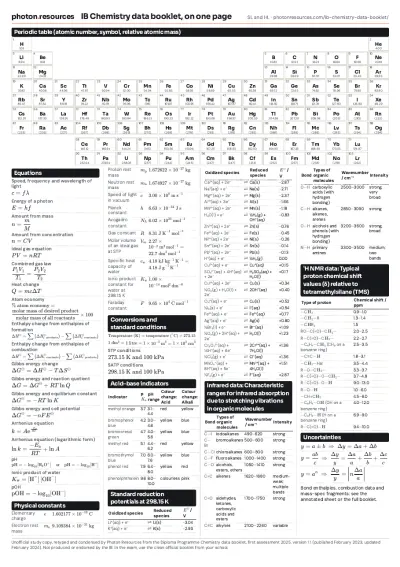
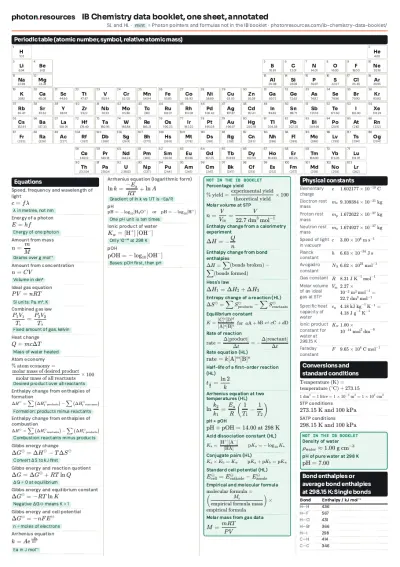
Photon Resources · IB Chemistry data booklet, annotated · photonresources.com/ib-chemistry-data-booklet/
1. Some relevant equations
Photon noteWavelength must be in metres when you use c = 3.00 × 10⁸ m s⁻¹, so convert nm first.
Photon noteThis is the energy of ONE photon; multiply by the Avogadro constant for a value per mole.
Photon noteWith m in grams, M is in g mol⁻¹ (the relative mass from the periodic table).
Photon noteV must be in dm³: divide cm³ by 1000 before you multiply.
Photon noteWith R = 8.31 use SI units only: P in Pa, V in m³, T in K.
Photon noteFor a fixed amount of gas; any units for P and V work if they match on both sides, but T must be in kelvin.
Photon notem is the mass of the substance being heated (usually the water), not the mass of the fuel or solid reactant.
Photon noteUse the balanced equation, so include stoichiometric coefficients when adding up the reactant masses.
Photon noteProducts minus reactants; elements in their standard states have a value of zero.
Photon noteThe order flips here: reactants minus products. Mixing this up with the formation version is a classic error.
Photon noteΔS is usually in J K⁻¹ mol⁻¹ and ΔH in kJ mol⁻¹: divide ΔS by 1000 before combining.
Photon noteShows how ΔG changes as a reaction mixture moves towards equilibrium, where ΔG = 0 and Q = K.
Photon noteA negative ΔG⦵ gives K > 1. Use ΔG⦵ in J mol⁻¹ because R is in J K⁻¹ mol⁻¹.
Photon noten is the number of moles of electrons transferred; the answer comes out in J mol⁻¹.
Photon noteEa in J mol⁻¹ here, to match R; a higher temperature or lower Ea gives a larger k.
Photon notePlot ln k against 1/T: the gradient is −Ea/R and the y-intercept is ln A.
Photon noteThe two forms mean the same thing; a change of 1 pH unit is a tenfold change in [H⁺].
Photon noteKw = 1.00 × 10⁻¹⁴ only at 298.15 K; it rises with temperature, so neutral pH is below 7 when hot.
Photon noteFind pOH for a base first, then convert to pH using pH + pOH = 14 at 298 K.
Not in the IB booklet · learn or derive these
Work out the theoretical yield from the limiting reactant.
Only for gases at STP; use PV = nRT at any other conditions.
The minus sign: the surroundings warm up in an exothermic reaction, so ΔH is negative. Convert Q to kJ.
Reactants minus products here, and only for gases.
The total enthalpy change is the same whichever route links the same start and end; reverse a step and flip its sign.
Elements have non-zero standard entropies, unlike enthalpies of formation.
Leave out pure solids and liquids; the reaction quotient Q has the same form with non-equilibrium concentrations.
The gradient of a concentration–time graph; draw a tangent for an instantaneous rate.
Orders come from experiment, not from the balanced equation.
A constant half-life is the sign of a first-order reaction.
Follows from subtracting the booklet's ln form at two temperatures; A cancels.
Comes from Kw = 1.00 × 10⁻¹⁴; at other temperatures use pKw.
For a weak acid assume [H⁺] = [A⁻] and that [HA] stays at its starting value.
Applies to an acid and its own conjugate base only.
Use reduction potentials from section 19 as printed; a positive E⦵cell means a spontaneous reaction.
Get the empirical formula from the mole ratio, dividing each amount by the smallest.
Combines PV = nRT with n = m/M; keep SI units throughout.
2. Physical constants
| Quantity | Symbol | Value |
|---|---|---|
| Elementary charge | e | 1.602177\times10^{-19}\ \text{C} |
| Electron rest mass | m_\text{e} | 9.109384\times10^{-31}\ \text{kg} |
| Proton rest mass | m_\text{p} | 1.672622\times10^{-27}\ \text{kg} |
| Neutron rest mass | m_\text{n} | 1.674927\times10^{-27}\ \text{kg} |
| Speed of light in vacuum | c | 3.00\times10^{8}\ \text{m s}^{-1} |
| Planck constant | h | 6.63\times10^{-34}\ \text{J s} |
| Avogadro constant | N_\text{A} | 6.02\times10^{23}\ \text{mol}^{-1} |
| Gas constant | R | 8.31\ \text{J K}^{-1}\,\text{mol}^{-1} Photon noteThe joules mean energies must be in J (not kJ) whenever R appears. |
| Molar volume of an ideal gas at STP | V_\text{m} | 2.27\times10^{-2}\ \text{m}^3\,\text{mol}^{-1}=22.7\ \text{dm}^3\,\text{mol}^{-1} Photon noteOnly at STP (273.15 K, 100 kPa); at other conditions use PV = nRT. |
| Specific heat capacity of water | c_\text{w} | 4.18\ \text{kJ kg}^{-1}\,\text{K}^{-1}=4.18\ \text{J g}^{-1}\,\text{K}^{-1} Photon noteWith mass in grams this gives Q in joules. |
| Ionic product constant for water at 298.15 K | K_\text{w} | 1.00\times10^{-14}\ \text{mol}^2\,\text{dm}^{-6} |
| Faraday constant | F | 9.65\times10^{4}\ \text{C mol}^{-1} Photon noteThe charge on one mole of electrons, F = N_A × e. |
3. Metric (SI) multipliers
| Prefix | Abbreviation | Value |
|---|---|---|
| peta | P | 10^{15} |
| tera | T | 10^{12} |
| giga | G | 10^{9} |
| mega | M | 10^{6} |
| kilo | k | 10^{3} |
| hecto | h | 10^{2} |
| deca | da | 10^{1} |
| deci | d | 10^{-1} |
| centi | c | 10^{-2} |
| milli | m | 10^{-3} |
| micro | μ | 10^{-6} |
| nano | n | 10^{-9} |
| pico | p | 10^{-12} |
| femto | f | 10^{-15} |
4. Unit conversions and standard conditions
Photon noteAny equation with T in it (gas laws, ΔG, Arrhenius) needs kelvin.
Photon noteFor PV = nRT, 1 dm³ = 10⁻³ m³ is the step most often missed.
Photon noteThe molar volume 22.7 dm³ mol⁻¹ applies here.
Photon noteStandard (⦵) thermodynamic data in the booklet refer to 298.15 K.
Not in the IB booklet · learn or derive these
So 1 cm³ of dilute solution is taken as 1 g in calorimetry.
Neutral means [H⁺] = [OH⁻], which is pH 7 only at 298 K.
Photon noteA wavelength scale from about 10⁻¹⁶ m to 10⁸ m running from gamma rays through X-rays, UV, visible, IR and microwaves to radio waves, with energy increasing towards short wavelengths; the visible band is roughly 400 nm (violet) to 700 nm (red).
7. The periodic table
Atomic number, symbol and relative atomic mass. Hover or tap an element for its name.
12. Bond enthalpies or average bond enthalpies at 298.15 K: Single bonds
| Bond | Enthalpy / kJ mol⁻¹ |
|---|---|
| H—H | 436 |
| H—F | 567 |
| H—Cl | 431 |
| H—Br | 366 |
| H—I | 298 |
| C—H | 414 |
| C—C | 346 |
| C—N | 286 |
| C—O | 358 |
| C—Si | 307 |
| C—P | 264 |
| C—S | 289 |
| C—F | 492 |
| C—Cl | 324 |
| C—Br | 285 |
| C—I | 228 |
| N—H | 391 |
| N—N | 158 |
| N—O | 214 |
| N—F | 278 |
| N—Cl | 192 |
| O—H | 463 |
| O—O | 144 |
| O—Si | 466 |
| O—P | 363 |
| O—F | 191 |
| O—Cl | 206 |
| O—Br | 201 |
| O—I | 201 |
| Si—H | 323 |
| Si—Si | 226 |
| Si—S | 293 |
| Si—F | 597 |
| Si—Cl | 400 |
| Si—Br | 330 |
| Si—I | 234 |
| P—H | 322 |
| P—P | 198 |
| P—F | 490 |
| P—Cl | 322 |
| P—Br | 264 |
| P—I | 184 |
| S—H | 364 |
| S—S | 266 |
| S—F | 327 |
| S—Cl | 271 |
| S—Br | 218 |
| F—F | 159 |
| F—Cl | 255 |
| F—Br | 249 |
| F—I | 280 |
| Cl—Cl | 242 |
| Cl—Br | 219 |
| Cl—I | 211 |
| Br—Br | 193 |
| Br—I | 178 |
| I—I | 151 |
Photon noteAverage values are for bonds in the gas phase, so bond-enthalpy answers differ a little from values worked out with enthalpies of formation. The booklet lays these out in four column pairs; we list them one pair after another.
12. Bond enthalpies or average bond enthalpies at 298.15 K: Multiple bonds
| Bond | Enthalpy / kJ mol⁻¹ |
|---|---|
| C=C | 614 |
| C=N | 615 |
| C=O | 804 |
| C=S | 536 |
| C≡C | 839 |
| C≡N | 890 |
| C≡O | 1077 |
| N=N | 470 |
| N=O | 587 |
| N≡N | 945 |
| O=O | 498 |
| O=S | 522 |
| S=S | 429 |
Photon noteBond enthalpy rises from single to double to triple bonds between the same atoms, and bond length falls; use the right bond order when you count bonds broken and formed.
14. Enthalpies of combustion
| Substance | Formula | State | \Delta H_\text{c}^\ominus / kJ mol⁻¹ |
|---|---|---|---|
| hydrogen | H₂ | g | −286 |
| sulfur | S | s | −297 |
| carbon (graphite) | C | s | −394 |
| carbon monoxide | CO | g | −283 |
| methane | CH₄ | g | −891 |
| ethane | C₂H₆ | g | −1561 |
| propane | C₃H₈ | g | −2219 |
| butane | C₄H₁₀ | g | −2878 |
| pentane | C₅H₁₂ | l | −3509 |
| hexane | C₆H₁₄ | l | −4163 |
| octane | C₈H₁₈ | l | −5470 |
| cyclohexane | C₆H₁₂ | l | −3920 |
| ethene | C₂H₄ | g | −1411 |
| buta-1,3-diene | C₄H₆ | g | −2541 |
| ethyne | C₂H₂ | g | −1301 |
| benzene | C₆H₆ | l | −3268 |
| methylbenzene | C₆H₅CH₃ | l | −3910 |
| naphthalene | C₁₀H₈ | s | −5156 |
| chloroethane | C₂H₅Cl | g | −1413 |
| iodoethane | C₂H₅I | l | −1463 |
| trichloromethane | CHCl₃ | l | −473 |
| methanol | CH₃OH | l | −726 |
| ethanol | C₂H₅OH | l | −1367 |
| propan-1-ol | C₃H₇OH | l | −2021 |
| butan-1-ol | C₄H₉OH | l | −2676 |
| cyclohexanol | C₆H₁₁OH | s | −3728 |
| phenol | C₆H₅OH | s | −3053 |
| ethoxyethane | (C₂H₅)₂O | l | −2724 |
| methanal | HCHO | g | −571 |
| ethanal | CH₃CHO | g | −1167 |
| benzaldehyde | C₆H₅CHO | l | −3525 |
| propanone | (CH₃)₂CO | l | −1790 |
| pentan-3-one | (C₂H₅)₂CO | l | −3100 |
| phenylethanone | CH₃COC₆H₅ | l | −4149 |
| methanoic acid | HCOOH | l | −255 |
| ethanoic acid | CH₃COOH | l | −874 |
| benzoic acid | C₆H₅COOH | s | −3228 |
| ethanedioic acid | (COOH)₂ | s | −243 |
| ethyl ethanoate | CH₃COOC₂H₅ | l | −2238 |
| ethanamide | CH₃CONH₂ | s | −1186 |
| methylamine | CH₃NH₂ | g | −1086 |
| phenylamine | C₆H₅NH₂ | l | −3393 |
| nitrobenzene | C₆H₅NO₂ | l | −3088 |
| urea | CO(NH₂)₂ | s | −633 |
| glucose | C₆H₁₂O₆ | s | −2803 |
| sucrose | C₁₂H₂₂O₁₁ | s | −5640 |
Photon noteValues are per mole of the substance burned, at 298.15 K and 100 kPa, with water formed as a liquid. Down a homologous series each extra CH₂ adds roughly 650 kJ mol⁻¹.
18. Acid–base indicators
| Indicator | pK_\text{a} | pH range | Colour change: Acid | Colour change: Alkali |
|---|---|---|---|---|
| methyl orange | 3.7 | 3.1–4.4 | red | yellow |
| bromophenol blue | 4.2 | 3.0–4.6 | yellow | blue |
| bromocresol green | 4.7 | 4.0–5.6 | yellow | blue |
| methyl red | 5.1 | 4.4–6.2 | red | yellow |
| bromothymol blue | 7.0 | 6.0–7.6 | yellow | blue |
| phenol red | 7.9 | 6.4–8.0 | yellow | red |
| phenolphthalein | 9.6 | 8.0–10.0 | colourless | pink |
Photon notePick an indicator whose colour-change range sits inside the steep part of the titration curve, i.e. its pKa is close to the pH at the equivalence point.
19. Standard reduction potentials at 298.15 K
| Oxidized species | Reduced species | E^\ominus / V | |
|---|---|---|---|
| Li⁺(aq) + e⁻ | ⇌ | Li(s) | −3.04 |
| K⁺(aq) + e⁻ | ⇌ | K(s) | −2.93 |
| Ca²⁺(aq) + 2e⁻ | ⇌ | Ca(s) | −2.87 |
| Na⁺(aq) + e⁻ | ⇌ | Na(s) | −2.71 |
| Mg²⁺(aq) + 2e⁻ | ⇌ | Mg(s) | −2.37 |
| Al³⁺(aq) + 3e⁻ | ⇌ | Al(s) | −1.66 |
| Mn²⁺(aq) + 2e⁻ | ⇌ | Mn(s) | −1.18 |
| H₂O(l) + e⁻ | ⇌ | ½H₂(g) + OH⁻(aq) | −0.83 |
| Zn²⁺(aq) + 2e⁻ | ⇌ | Zn(s) | −0.76 |
| Fe²⁺(aq) + 2e⁻ | ⇌ | Fe(s) | −0.45 |
| Ni²⁺(aq) + 2e⁻ | ⇌ | Ni(s) | −0.26 |
| Sn²⁺(aq) + 2e⁻ | ⇌ | Sn(s) | −0.14 |
| Pb²⁺(aq) + 2e⁻ | ⇌ | Pb(s) | −0.13 |
| H⁺(aq) + e⁻ | ⇌ | ½H₂(g) | 0.00 |
| Cu²⁺(aq) + e⁻ | ⇌ | Cu⁺(aq) | +0.15 |
| SO₄²⁻(aq) + 4H⁺(aq) + 2e⁻ | ⇌ | H₂SO₃(aq) + H₂O(l) | +0.17 |
| Cu²⁺(aq) + 2e⁻ | ⇌ | Cu(s) | +0.34 |
| ½O₂(g) + H₂O(l) + 2e⁻ | ⇌ | 2OH⁻(aq) | +0.40 |
| Cu⁺(aq) + e⁻ | ⇌ | Cu(s) | +0.52 |
| ½I₂(s) + e⁻ | ⇌ | I⁻(aq) | +0.54 |
| Fe³⁺(aq) + e⁻ | ⇌ | Fe²⁺(aq) | +0.77 |
| Ag⁺(aq) + e⁻ | ⇌ | Ag(s) | +0.80 |
| ½Br₂(l) + e⁻ | ⇌ | Br⁻(aq) | +1.09 |
| ½O₂(g) + 2H⁺(aq) + 2e⁻ | ⇌ | H₂O(l) | +1.23 |
| Cr₂O₇²⁻(aq) + 14H⁺(aq) + 6e⁻ | ⇌ | 2Cr³⁺(aq) + 7H₂O(l) | +1.36 |
| ½Cl₂(g) + e⁻ | ⇌ | Cl⁻(aq) | +1.36 |
| MnO₄⁻(aq) + 8H⁺(aq) + 5e⁻ | ⇌ | Mn²⁺(aq) + 4H₂O(l) | +1.51 |
| ½F₂(g) + e⁻ | ⇌ | F⁻(aq) | +2.87 |
Photon noteThe more positive E⦵, the stronger the oxidizing agent on the left; the more negative, the stronger the reducing agent on the right. Do not multiply E⦵ when you scale a half-equation.
20. Infrared data: Characteristic ranges for infrared absorption due to stretching vibrations in organic molecules
| Bond | Types of organic molecules | Wavenumber / cm⁻¹ | Intensity |
|---|---|---|---|
| C—I | iodoalkanes | 490–620 | strong |
| C—Br | bromoalkanes | 500–600 | strong |
| C—Cl | chloroalkanes | 600–800 | strong |
| C—F | fluoroalkanes | 1000–1400 | strong |
| C—O | alcohols, esters, ethers | 1050–1410 | strong |
| C=C | alkenes | 1620–1680 | medium-weak; multiple bands |
| C=O | aldehydes, ketones, carboxylic acids and esters | 1700–1750 | strong |
| C≡C | alkynes | 2100–2260 | variable |
| O—H | carboxylic acids (with hydrogen bonding) | 2500–3000 | strong, very broad |
| C—H | alkanes, alkenes, arenes | 2850–3090 | strong |
| O—H | alcohols and phenols (with hydrogen bonding) | 3200–3600 | strong, broad |
| N—H | primary amines | 3300–3500 | medium; two bands |
Photon noteA carboxylic acid shows both the very broad O—H band and the sharp C=O band; check for both before naming the functional group.
21. ¹H NMR data: Typical proton chemical shift values (δ) relative to tetramethylsilane (TMS)
| Type of proton | Chemical shift / ppm |
|---|---|
| —C\mathbf{H}_3 | 0.9–1.0 |
| —C\mathbf{H}_2—R | 1.3–1.4 |
| —C\mathbf{H}R₂ | 1.5 |
| RO—C(=O)—C\mathbf{H}_2— | 2.0–2.5 |
| R—C(=O)—C\mathbf{H}_2— | 2.2–2.7 |
| —C₆H₄—C\mathbf{H}_3 (CH₃ on a benzene ring) | 2.5–3.5 |
| —C≡C—\mathbf{H} | 1.8–3.1 |
| —C\mathbf{H}_2—Hal | 3.5–4.4 |
| R—O—C\mathbf{H}_2— | 3.3–3.7 |
| R—C(=O)—O—C\mathbf{H}_2— | 3.7–4.8 |
| R—C(=O)—O—\mathbf{H} | 9.0–13.0 |
| R—O—\mathbf{H} | 1.0–6.0 |
| —CH=C\mathbf{H}_2 | 4.5–6.0 |
| —C₆H₄—O\mathbf{H} (OH on a benzene ring) | 4.0–12.0 |
| —C₆H₄—\mathbf{H} (H on a benzene ring) | 6.9–9.0 |
| R—C(=O)—\mathbf{H} | 9.4–10.0 |
Photon noteR is an alkyl group and Hal is F, Cl, Br or I; values can shift with solvent and conditions. The booklet draws the C=O groups and benzene rings as structures: we write them as condensed formulas (C(=O) is a carbonyl, C₆H₄ a benzene ring) and, as in the booklet, the proton being described is in bold.
22. Mass spectral fragments lost
| Mass lost (M_\text{r}) | Possible neutral fragment lost |
|---|---|
| 15 | •CH₃ |
| 17 | •OH |
| 18 | H₂O |
| 28 | CH₂=CH₂, CO |
| 29 | •CH₂CH₃, •CHO |
| 31 | •OCH₃ |
| 45 | •COOH |
Photon noteRead these as gaps between the molecular ion peak and a fragment peak. Where the booklet lists two fragments side by side for one mass, we separate them with a comma.
23. Uncertainties
Photon noteAdding or subtracting: add the absolute uncertainties (e.g. two burette readings).
Photon noteMultiplying or dividing: add the fractional (or percentage) uncertainties.
Photon noteA power multiplies the fractional uncertainty by n.
Not in the IB booklet · learn or derive these
TMS gives one strong signal upfield of almost all organic protons, so it is used as the zero.
Protons on the same carbon, and O—H protons, usually do not split each other.
In the official booklet, not retyped here
- 8. Melting points and boiling points of the elements at 101.325 kPa A periodic-table layout giving each element's melting and boiling point in °C.
- 9. First ionization energy, electron affinity and electronegativity of the elements A periodic-table layout with first ionization energies and electron affinities in kJ mol⁻¹ (a few second EAs) and electronegativities.
- 10. Atomic and ionic radii of the elements A periodic-table layout with covalent (atomic) radii and common ionic radii with their charges, in units of 10⁻¹² m.
- 11. Covalent or average covalent bond lengths Lengths of common single and multiple bonds, in units of 10⁻¹² m.
- 13. Thermodynamic data (selected compounds) Standard enthalpy of formation, Gibbs energy of formation and standard entropy for over 40 selected compounds, mostly organic.
- 15. Colour wheel with wavelengths of the visible spectrum A colour wheel of red, orange, yellow, green, blue and violet with boundary wavelengths from 400 nm to 700 nm, for complementary colours.
- 16. Lattice enthalpies at 298.15 K (experimental values) Experimental Born–Haber lattice enthalpies for the alkali metal halides and a set of other ionic compounds.
- 17. Triangular bonding diagram (van Arkel–Ketelaar triangle) A triangle plotting electronegativity difference against average electronegativity, with regions for ionic, polar covalent, covalent and metallic bonding.
- 24. References The data sources the IB used for the tables.
These are long data tables. Use the official booklet for them.
Source: Diploma Programme Chemistry data booklet, first assessment 2025, version 1.1 (published February 2023, updated February 2024), retyped by Photon Resources. This is an unofficial study companion, not produced or endorsed by the International Baccalaureate. In the exam you use the clean official booklet your school provides. All notes and extra facts are ours.