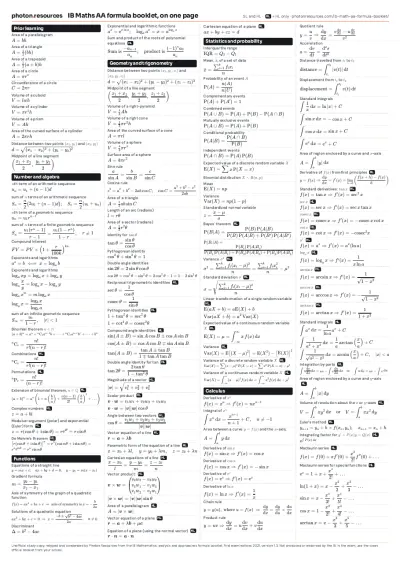
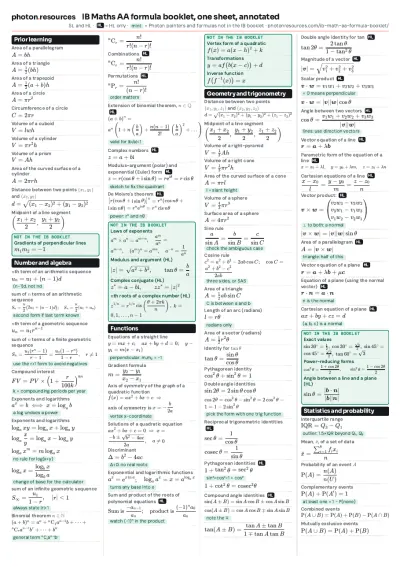
Photon Resources · IB Maths AA formula booklet, annotated · photonresources.com/ib-math-aa-formula-booklet/
Prior learning
SL and HL
Area of a parallelogram
A=bhwhere b is the base, h is the heightArea of a triangle
A=\tfrac{1}{2}(bh)where b is the base, h is the heightArea of a trapezoid
A=\tfrac{1}{2}(a+b)hwhere a and b are the parallel sides, h is the heightArea of a circle
A=\pi r^2where r is the radiusCircumference of a circle
C=2\pi rwhere r is the radiusVolume of a cuboid
V=lwhwhere l is the length, w is the width, h is the heightVolume of a cylinder
V=\pi r^2hwhere r is the radius, h is the heightVolume of a prism
V=Ahwhere A is the area of cross-section, h is the heightArea of the curved surface of a cylinder
A=2\pi rhwhere r is the radius, h is the heightPhoton noteTotal surface area of a closed cylinder adds the two ends: 2\pi rh+2\pi r^2.
Distance between two points (x_1,y_1) and (x_2,y_2)
d=\sqrt{(x_1-x_2)^2+(y_1-y_2)^2}Coordinates of the midpoint of a line segment with endpoints (x_1,y_1) and (x_2,y_2)
\left(\frac{x_1+x_2}{2},\ \frac{y_1+y_2}{2}\right)Not in the IB booklet · learn or derive these
Use it for normals and perpendicular bisectors.
Topic 1: Number and algebra
SL 1.2 SL and HL
The nth term of an arithmetic sequence
u_n=u_1+(n-1)dPhoton note(n-1)d, not nd: the first term has had no differences added yet.
The sum of n terms of an arithmetic sequence
S_n=\frac{n}{2}\big(2u_1+(n-1)d\big);\quad S_n=\frac{n}{2}(u_1+u_n)SL 1.3 SL and HL
The nth term of a geometric sequence
u_n=u_1r^{n-1}The sum of n terms of a finite geometric sequence
S_n=\frac{u_1(r^n-1)}{r-1}=\frac{u_1(1-r^n)}{1-r},\quad r\neq1SL 1.4 SL and HL
Compound interest
FV=PV\times\left(1+\frac{r}{100k}\right)^{kn}where FV is the future value, PV is the present value, n is the number of years, k is the number of compounding periods per year, r\% is the nominal annual rate of interestPhoton noteOn the calculator's finance solver, money you pay out is negative and money you receive is positive.
SL 1.5 SL and HL
Exponents and logarithms
a^x=b\iff x=\log_abwhere a>0, b>0, a\neq1SL 1.7 SL and HL
Exponents and logarithms
\log_axy=\log_ax+\log_ayPhoton noteThere is no rule for \log_a(x+y). Splitting it is a very common lost mark.
Photon noteChange of base: lets you evaluate any log with the calculator's \ln or \log key.
SL 1.8 SL and HL
The sum of an infinite geometric sequence
S_\infty=\frac{u_1}{1-r},\quad |r|<1Photon noteState the condition |r|<1 whenever you use it: it often carries a mark.
SL 1.9 SL and HL
Binomial theorem n\in\mathbb N
(a+b)^n=a^n+{}^n\mathrm{C}_1a^{n-1}b+\dots+{}^n\mathrm{C}_ra^{n-r}b^r+\dots+b^nPhoton noteThe general term is {}^n\mathrm C_r\,a^{n-r}b^r. Set the power of x you want and solve for r.
AHL 1.10 HL only
Combinations
{}^n\mathrm{C}_r=\frac{n!}{r!(n-r)!}Photon noteOrder does not matter.
Permutations
{}^n\mathrm{P}_r=\frac{n!}{(n-r)!}Photon noteOrder matters.
Extension of binomial theorem, n\in\mathbb Q
(a+b)^n=a^n\left(1+n\left(\frac{b}{a}\right)+\frac{n(n-1)}{2!}\left(\frac{b}{a}\right)^2+\dots\right)Photon noteValid only when \left|\dfrac{b}{a}\right|<1. State this interval of validity.
AHL 1.12 HL only
Complex numbers
z=a+b\mathrm{i}AHL 1.13 HL only
Modulus-argument (polar) and exponential (Euler) form
z=r(\cos\theta+\mathrm{i}\sin\theta)=r\mathrm{e}^{\mathrm{i}\theta}=r\,\mathrm{cis}\,\thetaPhoton noteFind \theta from a sketch of the Argand diagram: the calculator's \arctan gives the wrong quadrant half the time.
AHL 1.14 HL only
De Moivre's theorem
\big[r(\cos\theta+\mathrm{i}\sin\theta)\big]^n=r^n(\cos n\theta+\mathrm{i}\sin n\theta)=r^n\mathrm{e}^{\mathrm{i}n\theta}=r^n\,\mathrm{cis}\,n\thetaNot in the IB booklet · learn or derive these
Then fix the quadrant from the signs of a and b.
Non-real roots of a real polynomial come in conjugate pairs.
The n roots are equally spaced round a circle.
Topic 2: Functions
SL 2.1 SL and HL
Equations of a straight line
y=mx+c;\quad ax+by+d=0;\quad y-y_1=m(x-x_1)Gradient formula
m=\frac{y_2-y_1}{x_2-x_1}SL 2.6 SL and HL
Axis of symmetry of the graph of a quadratic function
f(x)=ax^2+bx+c\ \Rightarrow\ \text{axis of symmetry is } x=-\frac{b}{2a}Photon noteThe vertex is at x=-\dfrac{b}{2a}; substitute back to get its y-coordinate.
SL 2.7 SL and HL
Solutions of a quadratic equation
ax^2+bx+c=0\ \Rightarrow\ x=\frac{-b\pm\sqrt{b^2-4ac}}{2a},\quad a\neq0Discriminant
\Delta=b^2-4acPhoton note\Delta>0: two real roots; \Delta=0: one repeated root (the graph touches the axis); \Delta<0: no real roots.
SL 2.9 SL and HL
Exponential and logarithmic functions
a^x=\mathrm{e}^{x\ln a};\quad \log_aa^x=x=a^{\log_ax}where a,x>0, a\neq1AHL 2.12 HL only
Sum and product of the roots of polynomial equations of the form \sum_{r=0}^{n}a_rx^r=0
\text{Sum is } \frac{-a_{n-1}}{a_n};\quad \text{product is } \frac{(-1)^na_0}{a_n}Photon notea_n is the leading coefficient. Watch the (-1)^n sign for odd-degree polynomials.
Not in the IB booklet · learn or derive these
Vertex at (h,k). Found by completing the square.
Vertical stretch a, horizontal stretch \tfrac1b, shift c right and d up. Inside the bracket acts on x the opposite way.
Swap x and y, then make y the subject. The graph reflects in y=x.
Topic 3: Geometry and trigonometry
SL 3.1 SL and HL
Distance between two points (x_1,y_1,z_1) and (x_2,y_2,z_2)
d=\sqrt{(x_1-x_2)^2+(y_1-y_2)^2+(z_1-z_2)^2}Coordinates of the midpoint of a line segment with endpoints (x_1,y_1,z_1) and (x_2,y_2,z_2)
\left(\frac{x_1+x_2}{2},\ \frac{y_1+y_2}{2},\ \frac{z_1+z_2}{2}\right)Volume of a right-pyramid
V=\tfrac{1}{3}Ahwhere A is the area of the base, h is the heightVolume of a right cone
V=\tfrac{1}{3}\pi r^2hwhere r is the radius, h is the heightArea of the curved surface of a cone
A=\pi rlwhere r is the radius, l is the slant heightPhoton notel is the slant height, not the vertical height. Find it with Pythagoras: l=\sqrt{r^2+h^2}.
Volume of a sphere
V=\tfrac{4}{3}\pi r^3where r is the radiusSurface area of a sphere
A=4\pi r^2where r is the radiusPhoton noteA hemisphere's curved surface is 2\pi r^2; add \pi r^2 if it has a flat base.
SL 3.2 SL and HL
Sine rule
\frac{a}{\sin A}=\frac{b}{\sin B}=\frac{c}{\sin C}Photon noteGiven two sides and a non-included angle, check for a second (obtuse) solution: the ambiguous case.
Cosine rule
c^2=a^2+b^2-2ab\cos C;\quad \cos C=\frac{a^2+b^2-c^2}{2ab}Photon noteUse it for three sides, or two sides and the angle between them.
Area of a triangle
A=\tfrac{1}{2}ab\sin CPhoton noteC is the angle between sides a and b.
SL 3.4 SL and HL
Length of an arc
l=r\thetawhere r is the radius, \theta is the angle measured in radiansArea of a sector
A=\tfrac{1}{2}r^2\thetawhere r is the radius, \theta is the angle measured in radiansPhoton noteRadians only. Convert with 180^\circ=\pi rad.
SL 3.5 SL and HL
Identity for \tan\theta
\tan\theta=\frac{\sin\theta}{\cos\theta}SL 3.6 SL and HL
Pythagorean identity
\cos^2\theta+\sin^2\theta=1Double angle identities
\sin2\theta=2\sin\theta\cos\thetaPhoton notePick the version that leaves only one trig function in your equation.
AHL 3.9 HL only
Reciprocal trigonometric identities
\sec\theta=\frac{1}{\cos\theta}Pythagorean identities
1+\tan^2\theta=\sec^2\thetaAHL 3.10 HL only
Compound angle identities
\sin(A\pm B)=\sin A\cos B\pm\cos A\sin BPhoton noteNote the sign flips in the cosine version.
Double angle identity for tan
\tan2\theta=\frac{2\tan\theta}{1-\tan^2\theta}AHL 3.12 HL only
Magnitude of a vector
|\boldsymbol{v}|=\sqrt{v_1^2+v_2^2+v_3^2}where \boldsymbol v=\begin{pmatrix}v_1\\v_2\\v_3\end{pmatrix}AHL 3.13 HL only
Scalar product
\boldsymbol{v}\cdot\boldsymbol{w}=v_1w_1+v_2w_2+v_3w_3where \boldsymbol v=\begin{pmatrix}v_1\\v_2\\v_3\end{pmatrix}, \boldsymbol w=\begin{pmatrix}w_1\\w_2\\w_3\end{pmatrix}Photon notePerpendicular vectors have \boldsymbol v\cdot\boldsymbol w=0.
Angle between two vectors
\cos\theta=\frac{v_1w_1+v_2w_2+v_3w_3}{|\boldsymbol{v}||\boldsymbol{w}|}Photon noteFor the angle between two lines, use their direction vectors. Take the acute angle unless told otherwise.
AHL 3.14 HL only
Vector equation of a line
\boldsymbol{r}=\boldsymbol{a}+\lambda\boldsymbol{b}Photon note\boldsymbol a is a point on the line, \boldsymbol b its direction.
Parametric form of the equation of a line
x=x_0+\lambda l,\quad y=y_0+\lambda m,\quad z=z_0+\lambda nCartesian equations of a line
\frac{x-x_0}{l}=\frac{y-y_0}{m}=\frac{z-z_0}{n}AHL 3.16 HL only
Vector product
\boldsymbol{v}\times\boldsymbol{w}=\begin{pmatrix}v_2w_3-v_3w_2\\v_3w_1-v_1w_3\\v_1w_2-v_2w_1\end{pmatrix}where \boldsymbol v=\begin{pmatrix}v_1\\v_2\\v_3\end{pmatrix}, \boldsymbol w=\begin{pmatrix}w_1\\w_2\\w_3\end{pmatrix}Photon noteThe result is perpendicular to both \boldsymbol v and \boldsymbol w: the quickest way to find a normal.
Area of a parallelogram
A=|\boldsymbol{v}\times\boldsymbol{w}|where \boldsymbol v and \boldsymbol w form two adjacent sides of a parallelogramPhoton noteA triangle with these two sides has half this area.
AHL 3.17 HL only
Vector equation of a plane
\boldsymbol{r}=\boldsymbol{a}+\lambda\boldsymbol{b}+\mu\boldsymbol{c}Equation of a plane (using the normal vector)
\boldsymbol{r}\cdot\boldsymbol{n}=\boldsymbol{a}\cdot\boldsymbol{n}Cartesian equation of a plane
ax+by+cz=dPhoton noteThe coefficients (a,b,c) are a normal vector to the plane.
Not in the IB booklet · learn or derive these
Paper 1 has no calculator: learn the 30°, 45°, 60° values and their radian forms.
Rearranged from the booklet's \cos2\theta. Needed to integrate \sin^2x and \cos^2x (HL).
Sine, not cosine, because \boldsymbol n is perpendicular to the plane.
Topic 4: Statistics and probability
SL 4.2 SL and HL
Interquartile range
\text{IQR}=Q_3-Q_1Photon noteAn outlier is more than 1.5\times\text{IQR} below Q_1 or above Q_3.
SL 4.3 SL and HL
Mean, \bar x, of a set of data
\bar x=\frac{\sum_{i=1}^{k}f_ix_i}{n}where n=\sum_{i=1}^{k}f_iSL 4.5 SL and HL
Probability of an event A
\mathrm{P}(A)=\frac{n(A)}{n(U)}Complementary events
\mathrm{P}(A)+\mathrm{P}(A')=1Photon note“At least one” questions: 1-\mathrm P(\text{none}).
SL 4.6 SL and HL
Combined events
\mathrm{P}(A\cup B)=\mathrm{P}(A)+\mathrm{P}(B)-\mathrm{P}(A\cap B)Mutually exclusive events
\mathrm{P}(A\cup B)=\mathrm{P}(A)+\mathrm{P}(B)Photon noteMutually exclusive means \mathrm P(A\cap B)=0. That is not the same as independent.
Conditional probability
\mathrm{P}(A|B)=\frac{\mathrm{P}(A\cap B)}{\mathrm{P}(B)}Independent events
\mathrm{P}(A\cap B)=\mathrm{P}(A)\,\mathrm{P}(B)Photon noteTo test for independence, check whether this holds with the given numbers.
SL 4.7 SL and HL
Expected value of a discrete random variable X
\mathrm{E}(X)=\sum x\,\mathrm{P}(X=x)Photon noteA fair game has \mathrm E(\text{gain})=0.
SL 4.8 SL and HL
Binomial distribution X\sim\mathrm B(n,p)
Photon noteFour conditions: fixed n, two outcomes, constant p, independent trials. State them when asked to justify the model.
Mean
\mathrm{E}(X)=npVariance
\mathrm{Var}(X)=np(1-p)Photon noteStandard deviation is the square root of this.
SL 4.12 SL and HL
Standardized normal variable
z=\frac{x-\mu}{\sigma}Photon noteUsed to find an unknown \mu or \sigma: get z from the inverse normal on the calculator.
AHL 4.13 HL only
Bayes' theorem
\mathrm{P}(B|A)=\frac{\mathrm{P}(B)\,\mathrm{P}(A|B)}{\mathrm{P}(B)\,\mathrm{P}(A|B)+\mathrm{P}(B')\,\mathrm{P}(A|B')}Photon noteA tree diagram usually gets you there faster.
AHL 4.14 HL only
Variance \sigma^2
\sigma^2=\frac{\sum_{i=1}^{k}f_i(x_i-\mu)^2}{n}=\frac{\sum_{i=1}^{k}f_ix_i^2}{n}-\mu^2Standard deviation \sigma
\sigma=\sqrt{\frac{\sum_{i=1}^{k}f_i(x_i-\mu)^2}{n}}Linear transformation of a single random variable
\mathrm{E}(aX+b)=a\mathrm{E}(X)+bPhoton noteAdding b shifts the mean but not the spread.
Expected value of a continuous random variable X
\mathrm{E}(X)=\mu=\int_{-\infty}^{\infty}x\,f(x)\,\mathrm{d}xVariance
\mathrm{Var}(X)=\mathrm{E}\big[(X-\mu)^2\big]=\mathrm{E}(X^2)-\big[\mathrm{E}(X)\big]^2Variance of a discrete random variable X
\mathrm{Var}(X)=\sum(x-\mu)^2\,\mathrm{P}(X=x)=\sum x^2\,\mathrm{P}(X=x)-\mu^2Variance of a continuous random variable X
\mathrm{Var}(X)=\int_{-\infty}^{\infty}(x-\mu)^2f(x)\,\mathrm{d}x=\int_{-\infty}^{\infty}x^2f(x)\,\mathrm{d}x-\mu^2Not in the IB booklet · learn or derive these
The first step for any unknown in a discrete probability table.
The median m satisfies \int_{-\infty}^{m}f(x)\,\mathrm dx=\tfrac12.
Topic 5: Calculus
SL 5.3 SL and HL
Derivative of x^n
f(x)=x^n\Rightarrow f'(x)=nx^{n-1}Photon noteRewrite roots and fractions as powers first: \sqrt x=x^{1/2}, \dfrac1{x^2}=x^{-2}.
SL 5.5 SL and HL
Integral of x^n
\int x^n\,\mathrm{d}x=\frac{x^{n+1}}{n+1}+C,\quad n\neq-1Photon noteNever drop the +C on an indefinite integral.
Area between a curve y=f(x) and the x-axis, where f(x)>0
A=\int_a^by\,\mathrm{d}xSL 5.6 SL and HL
Derivative of \sin x
f(x)=\sin x\Rightarrow f'(x)=\cos xPhoton noteRadians only.
Derivative of \cos x
f(x)=\cos x\Rightarrow f'(x)=-\sin xDerivative of \mathrm e^x
f(x)=\mathrm{e}^x\Rightarrow f'(x)=\mathrm{e}^xDerivative of \ln x
f(x)=\ln x\Rightarrow f'(x)=\frac{1}{x}Chain rule
y=g(u),\ \text{where } u=f(x)\ \Rightarrow\ \frac{\mathrm{d}y}{\mathrm{d}x}=\frac{\mathrm{d}y}{\mathrm{d}u}\times\frac{\mathrm{d}u}{\mathrm{d}x}Product rule
y=uv\Rightarrow\frac{\mathrm{d}y}{\mathrm{d}x}=u\frac{\mathrm{d}v}{\mathrm{d}x}+v\frac{\mathrm{d}u}{\mathrm{d}x}Quotient rule
y=\frac{u}{v}\Rightarrow\frac{\mathrm{d}y}{\mathrm{d}x}=\frac{v\frac{\mathrm{d}u}{\mathrm{d}x}-u\frac{\mathrm{d}v}{\mathrm{d}x}}{v^2}Photon noteThe minus sign makes order matter: v\,u' comes first.
SL 5.9 SL and HL
Acceleration
a=\frac{\mathrm{d}v}{\mathrm{d}t}=\frac{\mathrm{d}^2s}{\mathrm{d}t^2}Distance travelled from t_1 to t_2
\text{distance}=\int_{t_1}^{t_2}|v(t)|\,\mathrm{d}tPhoton noteDistance uses |v|; displacement does not. Questions ask for both.
Displacement from t_1 to t_2
\text{displacement}=\int_{t_1}^{t_2}v(t)\,\mathrm{d}tSL 5.10 SL and HL
Standard integrals
\int\frac{1}{x}\,\mathrm{d}x=\ln|x|+CSL 5.11 SL and HL
Area of region enclosed by a curve and x-axis
A=\int_a^b|y|\,\mathrm{d}xPhoton noteIf the curve crosses the axis, split the integral at the root or use the modulus on the calculator.
AHL 5.12 HL only
Derivative of f(x) from first principles
y=f(x)\Rightarrow\frac{\mathrm{d}y}{\mathrm{d}x}=f'(x)=\lim_{h\to0}\left(\frac{f(x+h)-f(x)}{h}\right)Photon noteWrite “lim” on every line until you let h\to0.
AHL 5.15 HL only
Standard derivatives: \tan x
f(x)=\tan x\Rightarrow f'(x)=\sec^2x\sec x
f(x)=\sec x\Rightarrow f'(x)=\sec x\tan x\mathrm{cosec}\,x
f(x)=\mathrm{cosec}\,x\Rightarrow f'(x)=-\mathrm{cosec}\,x\cot x\cot x
f(x)=\cot x\Rightarrow f'(x)=-\mathrm{cosec}^2xa^x
f(x)=a^x\Rightarrow f'(x)=a^x(\ln a)\log_ax
f(x)=\log_ax\Rightarrow f'(x)=\frac{1}{x\ln a}\arcsin x
f(x)=\arcsin x\Rightarrow f'(x)=\frac{1}{\sqrt{1-x^2}}\arccos x
f(x)=\arccos x\Rightarrow f'(x)=-\frac{1}{\sqrt{1-x^2}}\arctan x
f(x)=\arctan x\Rightarrow f'(x)=\frac{1}{1+x^2}Standard integrals
\int a^x\,\mathrm{d}x=\frac{1}{\ln a}a^x+CAHL 5.16 HL only
Integration by parts
\int u\frac{\mathrm{d}v}{\mathrm{d}x}\,\mathrm{d}x=uv-\int v\frac{\mathrm{d}u}{\mathrm{d}x}\,\mathrm{d}x\quad\text{or}\quad\int u\,\mathrm{d}v=uv-\int v\,\mathrm{d}uPhoton noteChoose u as the part that gets simpler when differentiated (often a power of x, or \ln x).
AHL 5.17 HL only
Area of region enclosed by a curve and y-axis
A=\int_a^b|x|\,\mathrm{d}yVolume of revolution about the x or y-axes
V=\int_a^b\pi y^2\,\mathrm{d}x\quad\text{or}\quad V=\int_a^b\pi x^2\,\mathrm{d}yPhoton noteSquare first, then integrate. Limits must match the variable.
AHL 5.18 HL only
Euler's method
y_{n+1}=y_n+h\times f(x_n,y_n);\quad x_{n+1}=x_n+hwhere h is a constant (step length)Photon noteSet it up as a calculator table. Smaller h gives a better approximation.
Integrating factor for y'+P(x)y=Q(x)
\mathrm{e}^{\int P(x)\,\mathrm{d}x}Photon noteDivide through so that y' has coefficient 1 before finding P(x).
AHL 5.19 HL only
Maclaurin series
f(x)=f(0)+xf'(0)+\frac{x^2}{2!}f''(0)+\dotsMaclaurin series for special functions
\mathrm{e}^x=1+x+\frac{x^2}{2!}+\dotsPhoton noteSubstitute into these (for example x\to2x) rather than differentiating from scratch.
Not in the IB booklet · learn or derive these
If f''(x)=0, check the sign of f' either side. A point of inflexion needs f'' to change sign.
For example \int\mathrm e^{3x}\,\mathrm dx=\tfrac13\mathrm e^{3x}+C.
Differentiate every term with respect to x, then collect the \dfrac{\mathrm dy}{\mathrm dx} terms.
Only for the forms \tfrac00 or \tfrac{\infty}{\infty}. Say which form it is.
One +C is enough, on one side.
Source: IB Mathematics: analysis and approaches formula booklet, first examinations 2021, version 1.3, retyped by Photon Resources. This is an unofficial study companion, not produced or endorsed by the International Baccalaureate. In the exam you use the clean official booklet your school provides. All notes and extra formulas are ours.