Blog
IB Biology IA guide: criteria, research question and structure
The Biology IA is a 24-mark investigation into a question you write yourself, worth 20% of your grade. This guide explains the four criteria in plain words, how to build a research question around living systems that vary, how to treat ethics and sampling, and how to plan the weeks from idea to final report.
By Ejaz Ahmad · 22 October 2026 · 11 min read
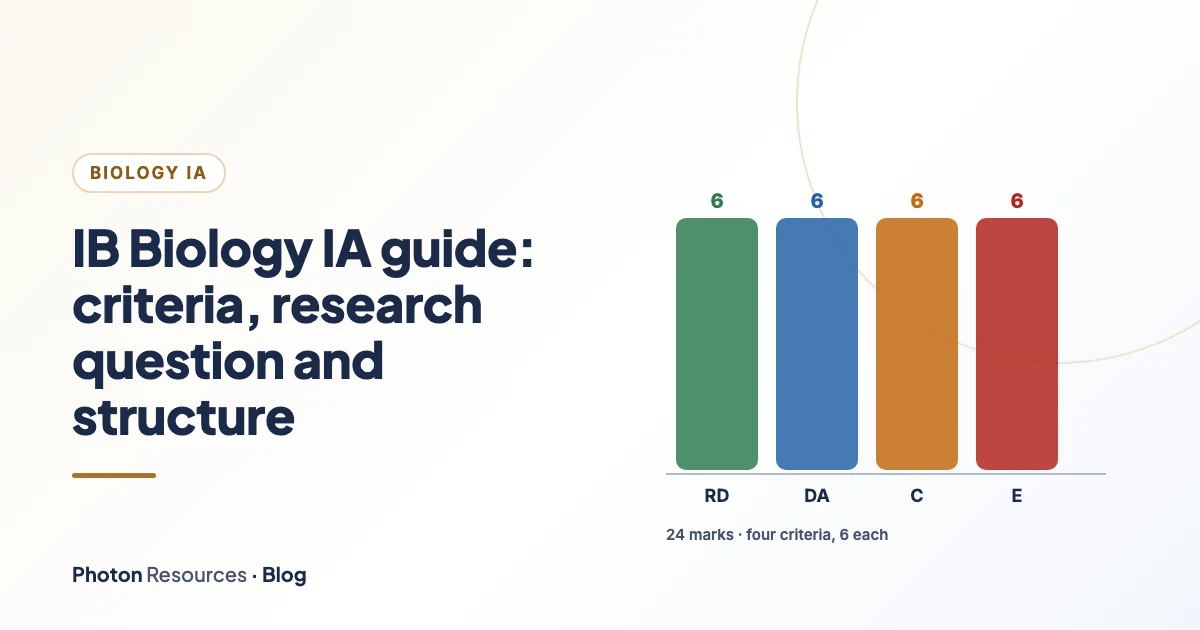
- 24 marks
- 3,000 words
- About 10 hours
- Ethics and sampling
- Research question
Biology is the IA where variation catches people out. Living things do not repeat themselves like a pendulum, so a sample of three and a mean with no spread cannot support a conclusion. The students who do well treat that variation as part of the story: they plan their sample, report a spread, pick a test that fits and say honestly what they could not control.
If you want ideas first, browse 25 Biology IA topic guides. Already drafting? Use the checklist.
Browse 25 Biology IA topic guides → Each has a set-up diagram, a sample graph and a plan.
What the IB Biology IA is
The Biology IA is the single piece of coursework in the subject. You pick a question, gather quantitative data (practical work, fieldwork, a database, a simulation or modelling), analyse it, conclude and evaluate. It is the same task and 24 marks at SL and HL.
| Fact | What to know |
|---|---|
| Weighting | 20% of your final Biology grade, at SL and at HL |
| Total marks | 24: four criteria of 6 marks each, the same at both levels |
| Time | About 10 hours, in and out of lessons |
| Length | 3,000 words of running prose at most. Charts, diagrams, data tables, equations, calculations and references do not count |
| Group work | Optional, up to three students, but your investigation, data and report are your own |
| Data | Must be quantitative. Lab work, fieldwork, spreadsheet modelling, a database or a simulation all qualify |
| Teacher help | Your teacher reads one draft and gives advice, but does not edit it |
Tables and calculations sit outside the limit but prose does not, so an argument hidden in a table must still be written as sentences. Your report opens with your title, candidate code, any partner codes and the word count.
Group work: you may share equipment and a similar method, but each of you must change a different independent variable, measure a different dependent variable or use a different slice of shared data. Group reports and identical raw data are not allowed. Our IA and EE guide compares this with the Maths IA and the Extended Essay, and the IA & EE Coach gives feedback on a draft.
How the IB Biology IA is marked
All four criteria are worth the same, so a strong report is balanced. Half the marks (Conclusion and Evaluation) are decided after the experiment. Students who spend nine of ten hours collecting data have little left for them.
These are our own plain-words summaries, not the IB's wording. Your teacher has the official criteria and the final say, so read those alongside this guide.
Research design (6 marks)
Is the question focused, and can the method answer it? The marker looks for clear variables, sensible controls and enough data to see a pattern despite biological variation. Ethics, safety and environmental impact belong in the design, not as an afterthought.
What moves it up
- Name the independent and dependent variable and the organism or system in the question.
- Base your prediction on a biological mechanism, not just a hunch.
- Plan the sample: how many organisms, quadrats or trials, how they are chosen and why that is enough.
- Name what you hold constant (temperature, pH, light) and what you cannot control.
- Write a real ethics section, not one line.
Common slips. A question with no organism; three repeats presented as a sample; controls that are listed but not monitored; an ethics section that is a single line or missing.
Data analysis (6 marks)
Process your data correctly and show it clearly, with uncertainty and spread carried through. In biology this typically means means, standard deviations or ranges, a graph with error bars, and a statistical test where it fits.
What moves it up
- Report counts or rates with sample size and a measure of spread.
- Show one worked example of each calculation.
- Choose a graph that suits the data type, with error bars and labelled axes.
- Pick a test that matches the data (t-test, correlation, chi-squared) and check its conditions first.
- Read a p-value as evidence, not proof.
Common slips. Means with no spread; a t-test on data that is not suitable; a trendline that implies causation; rounding that hides real differences.
Conclusion (6 marks)
Answer your own question using the analysis, and compare it with accepted biology: a known mechanism, a published range or a textbook relationship. Keep the claim in proportion to the evidence.
What moves it up
- State the outcome in the words of the question, with the statistic that supports it.
- Say whether the difference is bigger than the spread.
- Link to the biological mechanism from your background.
- Avoid generalising beyond your organism, range or site.
Common slips. "This proves"; a conclusion that ignores overlapping error bars; failing to mention a published value; extending a result from one species to all.
Evaluation (6 marks)
Be honest about what limited the result. In biology this includes sample size, uncontrolled environmental variables, subjectivity in scoring and organism variability, but each must be tied to something in your data.
What moves it up
- Link each weakness to evidence: wide spread, an outlier, a pattern against position or time.
- Rank weaknesses by effect and say whether each is random or systematic.
- Offer improvements that fix named weaknesses, such as a bigger sample, a water bath or blind scoring.
- Propose an extension that follows from your finding.
Common slips. "Human error" alone; "small sample" with no number; ignoring uncontrolled light or temperature; improvements that are only "be more careful".
From my classes
Plan the sample on paper
At Photon Academy I ask students for one sentence before any practical: "I will use N of these, chosen like this, because...". It sounds small, but it is the sentence most weak Biology IAs are missing.
See how IB grade boundaries work for how these marks feed your grade, and IB command terms for what "evaluate" and "justify" ask of you.
IB Biology IA research question examples
A weak research question is a topic with a question mark. The test: can a stranger name the independent variable, the dependent variable and the organism or system? If not, follow the funnel below.
| Too vague | Better (ours, for illustration) | Why it improves |
|---|---|---|
| Osmosis | How does the concentration of sucrose solution (0 to 0.8 mol dm⁻³) affect the percentage change in mass of potato cores after 60 minutes? | Names the tissue, both variables and the range. |
| Plants and light | How does the colour of light (red, green, blue) affect the number of oxygen bubbles released per minute by Elodea? | A measurable rate from a living system, with a clear mechanism. |
| Diversity in a field | How does the distance from a footpath (0 to 10 m) affect the number of plant species in 0.25 m² quadrats? | A fieldwork design with sampling units and a gradient. |
| Stomata | How does leaf position (sun or shade) affect stomatal density in leaves of one tree species? | Compares two groups with a count that can be tested statistically. |
Three checks before you commit. Can I vary it widely and repeat enough? Think about how many organisms or quadrats you can really manage. Is there a mechanism? The conclusion needs a known biological reason to compare with. Is it ethical? Avoid harm to animals (many schools will not allow vertebrate work at all); with people, participation must be voluntary, informed and anonymous. A twist such as a different tissue, habitat or data set is what makes it yours.
IB Biology IA ideas
Good Biology IA ideas have a method you can run and a twist of your own. Three from our explorer, each with a set-up diagram, a sample graph and a plan:
- Potato cores: does salt or sugar pull more water?: a classic osmosis practical with a comparison built in.
- Transpiration and the air's drying power: links a plant process to a measurable humidity variable.
- Stomata: sun leaves vs shade leaves: cheap, field-friendly and ideal for a statistical test.
That is three of 25. The Biology IA topic explorer holds the rest, each with a "make it yours" twist so you do not hand in the same report as everyone else.
IB Biology IA structure and word count
The IB does not prescribe headings, but a structure that follows the criteria makes it easy for the marker to find evidence. Because only prose counts towards 3,000 words, plan a budget before you write. A sensible split is below.
| Section | Budget | What goes in it |
|---|---|---|
| Question and background | About 400 | The question, the biology, the mechanism and a prediction. |
| Method | About 550 | Variables, sampling plan, controls, procedure, safety, ethics and environment, a labelled diagram. |
| Analysis | About 650 | Raw tables (outside the count), one worked example, mean and spread, graph, test and what it shows, in words. |
| Conclusion | About 550 | Your answer, the statistic behind it and the comparison with accepted biology. |
| Evaluation | About 700 | Ranked weaknesses tied to the data, random or systematic, specific improvements and an extension. |
Charts, tables, equations and calculations sit outside the 3,000 words, prose does not. Reference all sources, including images and data sets.
IB Biology IA timeline: from idea to final report
Ten hours is not long, so spread it across weeks and protect the later stages. A realistic plan is below.
- Weeks 1 to 2. Choose a system, pilot it to fix the range and sample size, then write the question, prediction and ethics section.
- Weeks 3 to 4. Collect more trials than you think you need, and record the conditions you cannot control.
- Week 5. Calculate means and spread, graph with error bars, choose and run a test that suits the data.
- Weeks 6 to 7. Write the whole report, check it against the criteria, then use your teacher's one round of feedback.
- Week 8. Check word count, references, units and axis labels, and submit.
In my experience, a pilot run on Friday saves a month. One tea-time test of your apparatus tells you whether the sample can be big enough and whether the effect is visible at all.
IB Biology IA checklist before you submit
- The question names both variables and the organism or system.
- A sampling plan with a stated sample size, chosen on purpose.
- Controls explained and monitored, and uncontrolled variables named.
- A real ethics, safety and environment section.
- Raw data with units and spread; one worked example per calculation.
- A graph with labelled axes and error bars, and a suitable statistical test with its conditions checked.
- Conclusion answers the question, uses the statistic and compares with accepted biology.
- Evaluation with ranked, specific weaknesses linked to the data and matching improvements.
- Under 3,000 words of prose, with title, candidate code and word count at the start.
- All sources referenced and the work entirely your own.
The IB treats work written or heavily edited by someone else, or by an AI tool, as not yours. Feedback is fine; writing is not. If you use a tool for ideas or checking, say so and cite it.
Where to go next
Official background is on the IB Diploma Programme page, and your teacher holds the current criteria. For the biology behind your question, Khan Academy Biology is clear, and its statistics course covers the tests you may need. The Royal Society of Biology is a good place for context on current research.
On this site, see uncertainties and error bars (the same logic applies to biology data), IB command terms and the topic cheatsheets. The IA and EE guide compares all the IAs; siblings are the Physics, Chemistry and Math IA guides. Practise the content with the free Biology practice topics (HL and SL), and read tips for a grade 7 in IB.
6 Biology IA ideas to start with
- Capillary rise: can xylem lift a tree by itself?
- Does heat-loving mean GC-rich?
- Build a tree from protein sequences
- Does mowing change what grows?
- Species–area on a school field
- Do heat-loving proteins have more charged residues?
See all 25 in the Biology IA ideas explorer.
Feedback, never written for you
Check your draft with the IA & EE Coach
The IA & EE Coach reads your draft against the criteria and asks questions about the gaps. It never writes or rewrites any of it. Start from the Biology IA topic explorer if you still need an idea.