Blog
IB Physics IA guide: criteria, research question and structure
The Physics IA is a 24-mark investigation into a question you write yourself, worth 20% of your grade. This guide explains how it is marked in plain words, how to turn a loose topic into a research question you can answer, how to spend 3,000 words, and how to plan eight weeks from first idea to final report.
By Ejaz Ahmad · 22 October 2026 · 11 min read
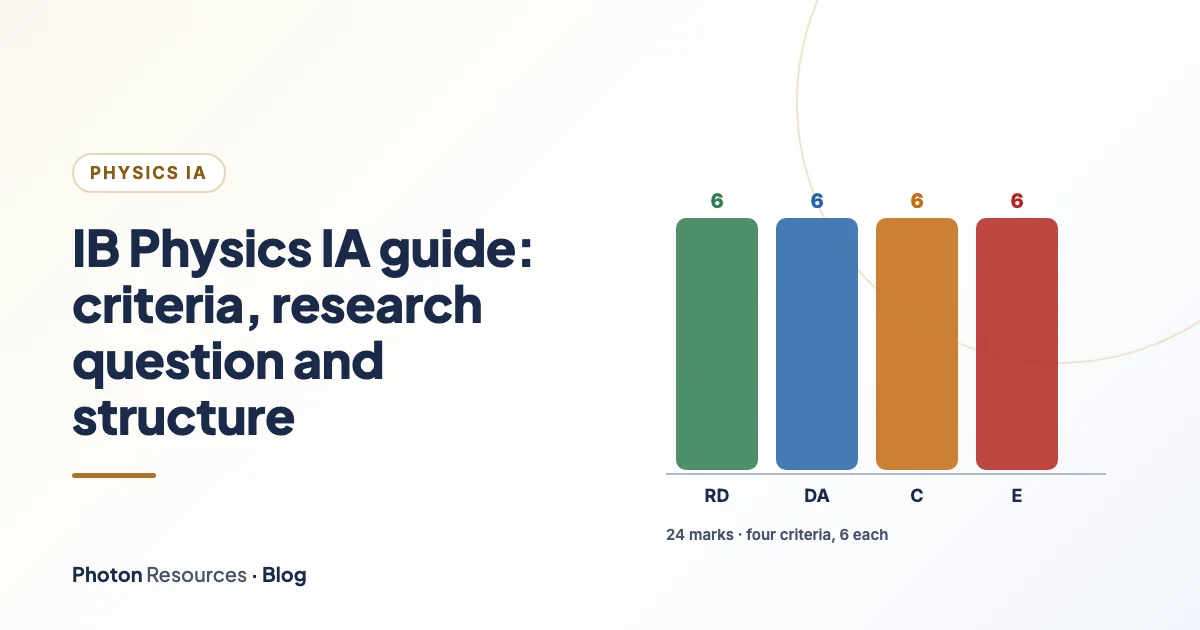
- 24 marks
- 3,000 words
- About 10 hours
- Research question
- Timeline and checklist
Every year I watch students lose Physics IA marks for reasons unrelated to how clever the physics was: a question with no variables, uncertainties calculated and then forgotten, an evaluation that says "human error". None of that needs talent to fix, only a clear picture of what the marker wants and a plan that leaves time for the last two criteria.
If you would rather start from ideas, jump to 30 Physics IA topic guides. If you are mid-draft, go straight to the checklist.
Browse 30 Physics IA topic guides → Each has a set-up diagram, a sample graph and a plan.
What the IB Physics IA is
The Physics IA, sometimes called the scientific investigation, is the one piece of coursework in the subject. You pick a question, collect or find quantitative data, process it, draw a conclusion and evaluate your method, then write it up. It is the same task at SL and HL and the same 24 marks, so an SL student can score as high as an HL student. The facts at a glance:
| Fact | What to know |
|---|---|
| Weighting | 20% of your final Physics grade, at SL and at HL |
| Total marks | 24: four criteria of 6 marks each, the same at both levels |
| Time | About 10 hours, in and out of lessons |
| Length | 3,000 words of running prose at most. Charts, diagrams, data tables, equations, calculations and references do not count |
| Group work | Optional, up to three students, but your investigation, data and report are your own |
| Data | Must be quantitative. Lab work, fieldwork, spreadsheet modelling, a database or a simulation all qualify |
| Teacher help | Your teacher reads one draft and gives advice, but does not edit it |
Tables and calculations sit outside the limit but prose does not, so an argument hidden in a table must still be written as sentences. Your report opens with your title, candidate code, any partner codes and the word count.
Group work: you may share equipment and a similar method, but each of you must change a different independent variable, measure a different dependent variable or use a different slice of shared data. Group reports and identical raw data are not allowed. Our IA and EE guide compares this with the Maths IA and the Extended Essay, and the IA & EE Coach gives feedback on a draft.
How the IB Physics IA is marked
All four criteria are worth the same, so a strong report is balanced. Half the marks (Conclusion and Evaluation) are decided after the experiment. Students who spend nine of ten hours collecting data have little left for them.
These are our own plain-words summaries, not the IB's wording. Your teacher has the official criteria and the final say, so read those alongside this guide.
Research design (6 marks)
The marker wants to see that your question is focused and that your method could really answer it. That means the independent and dependent variables are clear, the controls are chosen for physical reasons, and you will collect enough data across a wide enough range to see a pattern.
What moves it up
- Write a question where both variables, and the system, are obvious on one reading.
- Back the method with background physics and a prediction, ideally a formula you can test.
- Choose at least five values of the independent variable over a wide range, each repeated.
- Say how each control is kept constant and how you will check that it was.
- Explain why you chose this apparatus and this range, not only what you used.
Common slips. A question that names a topic ("friction") instead of a relationship; a narrow range such as 20 to 30 cm; controls listed but never measured; a method copied from a worksheet with no reasoning.
Data analysis (6 marks)
This criterion is about what you do with the numbers: recording them clearly, processing them correctly and showing what they mean. Uncertainty is the heart of it. A reader should be able to follow one calculation from raw reading to final result and see the uncertainty carried the whole way.
What moves it up
- Record raw data in tables with units and an uncertainty for each column.
- Show one worked example of each type of calculation, not forty copies.
- Pick a graph that straightens your relationship, and add error bars.
- Find the gradient or intercept with its uncertainty from maximum and minimum lines.
- Describe the graph in words so the reader does not have to guess.
Common slips. Uncertainties calculated once and then dropped; a graph with no error bars; a trendline forced through the origin without a reason; rounding that erases the real differences between values. Our guide to uncertainties, error bars and gradients covers each of these step by step.
Conclusion (6 marks)
Here you answer your own question. The answer must come from your analysis, be expressed with its uncertainty, and be compared with accepted physics: a formula, a data-book value or a published figure. The comparison is the key move. Saying your result is "close" is not enough; you need to say whether the difference is within your uncertainty.
What moves it up
- State the result as a number or a trend, in the words of the research question.
- Compare it with a theoretical or accepted value and use your uncertainty to judge the agreement.
- Tie it back to the physics from your introduction.
- Claim no more than the data range supports.
Common slips. A conclusion that restates the method; "the hypothesis was proved" from one set of runs; extending the result beyond the range tested; forgetting the accepted value altogether.
Evaluation (6 marks)
The marker is looking for honesty and precision about what limited your result. Specific weaknesses, linked to visible effects in your data, and improvements that would genuinely fix them, score far above a general list of things that could have gone wrong.
What moves it up
- Link each weakness to evidence: scatter, an offset, a curve that leaves the prediction.
- Say which weaknesses mattered most, and why.
- Tell the reader whether each error is random or systematic and which way it pushes the result.
- Make each improvement answer a named weakness, then suggest a realistic extension.
Common slips. "Human error", used alone; a long unranked list; "use better equipment" with no detail; ignoring a problem that is plain on the graph.
From my classes
The two-column trick
At Photon Academy I ask students to put every weakness in two columns: what went wrong, and where it shows in the data. If the second column is empty, the weakness is a guess, and it usually does not belong in the evaluation.
See how IB grade boundaries work for how these marks feed your grade, and IB command terms for what "evaluate" and "justify" ask of you.
IB Physics IA research question examples
A weak research question is a topic wearing a question mark. The test: can a stranger read yours and name the independent variable, the dependent variable and the system? If not, narrow it, following the funnel below.
| Too vague | Better (ours, for illustration) | Why it improves |
|---|---|---|
| How does friction work? | How does the mass of a block affect the maximum static friction on a wooden ramp, for masses of 100 to 600 g? | Names both variables, the surface and the range. |
| Pendulums and gravity | How does the release angle (5 to 60 degrees) affect the period of a 0.60 m pendulum? | Moves from a topic to a variable you can change and a range that tests the small-angle rule. |
| Does a magnet slow down in a pipe? | How does the wall thickness of a copper tube affect the fall time of a neodymium magnet? | One change, one measurement, and a clear theory (induced currents) to predict from. |
| Heat and insulation | How does the number of paper layers around a beaker change the cooling constant of 100 g of hot water? | A measurable outcome (the constant) from a fitted curve rather than a vague "how fast". |
Before you commit, run three quick checks. Can I vary it widely? Five values spanning a factor of at least two or three is a good target. Can I predict it? If you cannot write a relationship from the physics, the conclusion will be thin. Can I measure it with the kit I have? Try a quick pilot in one lesson; ten minutes with a phone camera can save a month.
Notice that none of these questions asks "why". "How does X affect Y" or "to what extent does X follow Y" is a question numbers can answer. Fieldwork, simulations, databases and spreadsheet models are all valid sources if the data is quantitative and the choices are yours.
IB Physics IA ideas
Good Physics IA ideas have a standard theory to test and a twist that lets you add something of your own. The twist is what makes it personal. Here are three from our explorer, each with a guide that shows the set-up, a sample graph and a step-by-step plan:
- Pendulum: when does the small-angle rule break?: a familiar experiment turned into a test of where a textbook approximation fails.
- Cooling water: how well does Newton's law fit?: cheap kit, lots of data, and a clear exponential model to fit.
- LED colours: can you measure Planck's constant?: a modern-physics link from a few LEDs and a multimeter.
That is three of 30. The Physics IA topic explorer holds the rest, each with a "make it yours" twist so you do not hand in the same report as everyone else.
IB Physics IA structure and word count
The IB does not prescribe headings, but a structure that follows the criteria makes it easy for the marker to find evidence. Because only prose counts towards 3,000 words, plan a budget before you write. A sensible split is below.
| Section | Budget | What goes in it |
|---|---|---|
| Question and background | About 400 | The question, the physics behind it, the equation you will test and a prediction. |
| Method | About 500 | Variables with how each is changed, measured or controlled; apparatus and why; safety, ethics and environment; a labelled diagram. |
| Analysis | About 700 | Raw data tables (outside the count), one worked example, uncertainties, graph, gradient or fit with its uncertainty, described in words. |
| Conclusion | About 600 | Your answer, comparison with accepted physics, the role of your uncertainty. |
| Evaluation | About 650 | Ranked weaknesses linked to the data, random or systematic, and specific improvements and an extension. |
Charts, tables, equations and calculations sit outside the count, but do not use that as a way to smuggle in explanation. If a point needs a sentence, write the sentence. Reference everything you took from elsewhere, including images, data and simulations: missing references are treated as an academic honesty problem.
IB Physics IA timeline: from idea to final report
Ten hours is not long, so spread it across weeks and protect the later stages. A realistic plan is below.
- Weeks 1 to 2: idea and pilot. Browse topics, pick one, test the apparatus for ten minutes and fix the range. Write the question and a prediction.
- Weeks 3 to 4: collect data. Take more values and repeats than you think you need. Log conditions, and keep your raw data safe.
- Week 5: process. Work out uncertainties as you go, build the graph with error bars and extract the gradient with its uncertainty.
- Weeks 6 to 7: draft, feedback and revise. Write the whole report. Your teacher reads one draft, so make it complete and read it against the criteria first.
- Week 8: finish. Check the word count, references, units and graph labels. Submit the final version.
In my experience, students who finish data in week three and then leave it until week six rarely write a good evaluation. Use the gap to look at the graph critically and repeat one awkward point.
IB Physics IA checklist before you submit
- The question names the independent variable, the dependent variable and the system.
- At least five values over a wide range, each repeated, with controls explained.
- Safety, ethical and environmental issues addressed before the method.
- Raw data in tables with units and uncertainties.
- One worked example of each calculation and uncertainties carried through.
- A suitable graph with axis labels, units and error bars, and a gradient or fit with its uncertainty.
- A conclusion that answers the question and compares with accepted physics using the uncertainty.
- An evaluation with ranked, specific weaknesses and improvements, each linked to the data.
- Under 3,000 words of prose, with title, candidate code and word count at the start.
- All sources referenced and the work entirely your own.
One boundary matters. The IB treats work that someone else, or an AI tool, wrote or heavily edited as not yours. Feedback on a draft is fine; having it written for you is not. If you use a tool for ideas or checking, say so and cite it.
Where to go next
Official background on the course sits on the IB Diploma Programme page, and your teacher holds the current criteria. For uncertainty methods, the NIST guide to uncertainty of measurement is clear and free, and the PhET simulations are good for piloting an idea before you build it.
On this site, see uncertainties in IB Physics, the annotated Physics data booklet, and the full IA and EE guide. Writing a Chemistry or Biology IA instead? See the Chemistry IA guide and the Biology IA guide, or the Math IA guide. Practise the content with the free Physics practice topics (HL and SL). For how the course changed from 2025, read what changed in IB Physics from 2025.
6 Physics IA ideas to start with
- Projectile: is the best launch angle really 45°?
- Friction: is the coefficient really a constant?
- Paper cones: what sets the terminal speed?
- Trolley on a ramp: how much energy does friction take?
- Specific heat capacity: can you beat the heat loss?
- Salt and ice: how fast does a block melt in brine?
See all 30 in the Physics IA ideas explorer.
Feedback, never written for you
Check your draft with the IA & EE Coach
The IA & EE Coach reads your draft against the criteria and asks questions about the gaps. It never writes or rewrites any of it. Start from the Physics IA topic explorer if you still need an idea.