Blog
IB Math IA guide: criteria, topics and structure
The Maths exploration is a 20-mark piece of writing about mathematics you chose, worth 20% of your grade. This guide explains the five criteria in plain words, how to pick a topic and aim that you can sustain, how to spend 12 to 20 pages, and how to plan the weeks from first idea to final report.
By Ejaz Ahmad · 22 October 2026 · 11 min read
- 20 marks
- 12 to 20 pages
- 5 criteria
- AA and AI, SL and HL
- Timeline and checklist
The Maths IA is unlike the exam, and that is why good students are caught out by it. There is no right answer to match, no formula to remember under pressure, and nobody tells you what to explore. What the marker rewards is a clear aim, mathematics used at the right level and understood, and evidence that the piece is yours. Page count and difficulty alone do not do it.
Looking for ideas? Browse 40 Math IA topic guides. To see what strong and weak work look like criterion by criterion, read IB Math IA examples: what top marks look like. Mid-draft? Go to the checklist.
What the IB Math IA is
The IA is an exploration: a written piece, usually 12 to 20 pages, in which you investigate a mathematical question of your own choice and show how the mathematics answers it. The task is the same in Analysis and Approaches (AA) and Applications and Interpretation (AI), and at SL and at HL. The difference between courses shows up in criterion E, where HL asks for more sophistication and rigour.
| Fact | What to know |
|---|---|
| Weighting | 20% of your final Maths grade |
| Total marks | 20, across five criteria (A to E) |
| Length | About 12 to 20 pages including graphs and diagrams, bibliography excluded. Quality of the mathematics matters more than length |
| Time | About 10 to 15 hours |
| Work | Individual: your own topic and your own writing. There are no group explorations |
| Format | Word-processed or handwritten; the title page shows the title and page count |
| Teacher help | Advice during the process and a pointer to errors, but no correcting of the work |
| Sources | Everything you use must be referenced. Direct quotes need acknowledging |
Check the exact criteria with your teacher, and use the documents for your own exam session. The rest of this guide describes the current version.
How the IB Math IA is marked
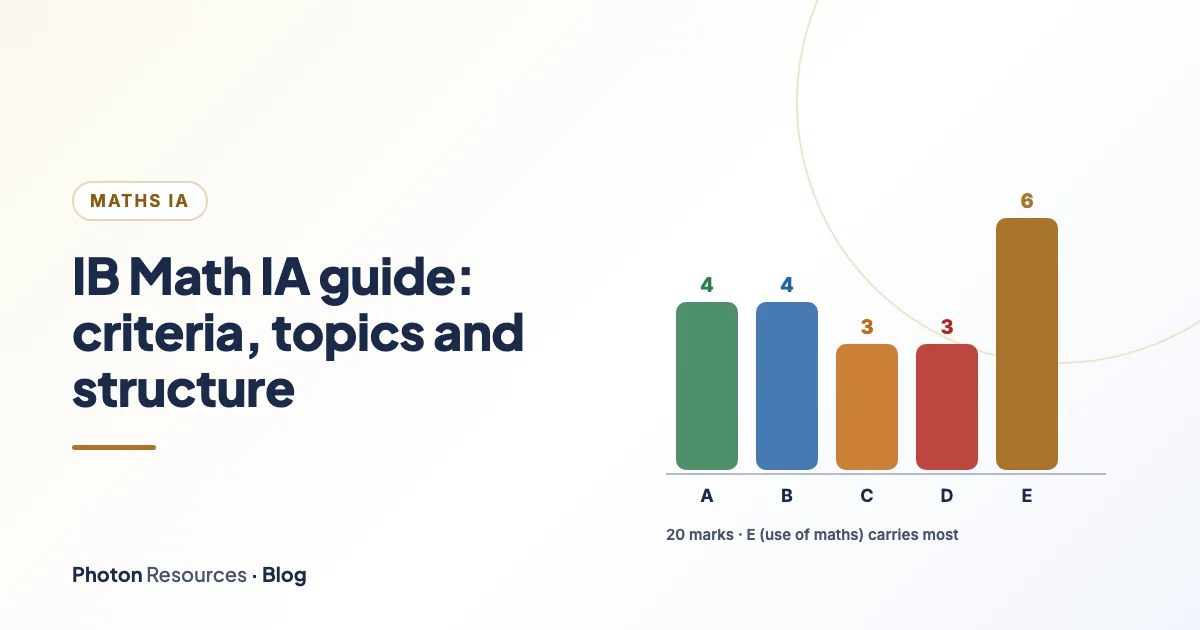
There are five criteria. The largest by far is E, Use of mathematics, with 6 of the 20 marks, but the other four add up to 14, so a well-made exploration with plain mathematics can still do well while a clever but disorganised one cannot.
These are our own plain-words summaries, not the IB's wording. Your teacher has the official criteria.
A. Presentation (4 marks)
A reader can follow your exploration from aim to conclusion: a sensible order, a stated aim, and nothing included that does not earn its place. Being concise is rewarded.
What moves it up
- State the aim or question early, within the first page or two.
- Say why you chose it and how the mathematics will be used.
- Place graphs and tables next to the text that uses them.
- End by returning to the aim and saying whether it was met.
Common slips. No aim; pages of history or definitions that the mathematics never uses; five near-identical worked examples instead of one plus a table; spreadsheet screenshots filling a page.
B. Mathematical communication (4 marks)
Clear, correct mathematical writing: defined terms, proper notation and suitable representations that a peer could follow.
What moves it up
- Define each symbol where it first appears, with units.
- Write notation as a mathematician would, not as the calculator shows it (x² not x^2).
- Label graphs: titles, axes with units, a scale that suits the data.
- Explain software output and restate the key result in proper notation.
Common slips. Computer syntax such as 1.2E-3 in your own prose; one symbol used for two things; derivations that jump; a regression screenshot with no comment. Our GDC guide helps with reading calculator output.
C. Personal engagement (3 marks)
Evidence that the exploration is yours: your own question, data or angle, visible in the pages. Hard work does not count unless it shows.
What moves it up
- Make at least two decisions visible and explain them.
- Collect, choose or filter your own data, with reasons.
- Make a prediction before a calculation, then test it.
- Go one step past the textbook treatment.
Common slips. "I have always been interested in..." with nothing in the mathematics to match; the same popular topic done the standard way; changing only the numbers in a website example; the personal link vanishing after page one.
D. Reflection (3 marks)
Thinking about what your results mean and how good your approach is, built into the exploration rather than saved for the end.
What moves it up
- Reflect at several points: after a poor fit, a surprise or a change of method.
- Name limits of your model tied to its assumptions or data.
- Compare two methods or models and judge between them.
- Say what follows from your result or what you would test next, with a reason.
Common slips. One paragraph at the end that summarises; "human error" or "limited time" as the only limitations; calling a model accurate without any measure of accuracy.
E. Use of mathematics (6 marks)
Mathematics that is relevant, correct, understood and at the right level for your course. Doing a few things properly beats doing many things lightly. At HL the top marks also ask for sophistication and rigour, and precision.
What moves it up
- Draw the core mathematics from the course (or close to it), not only from before it.
- Give a reason for each method: why this model, test or technique here.
- Show key steps by hand rather than a software answer.
- Sense-check results: units, size, a limiting case, a known value.
- At HL, justify or prove main claims and link areas of mathematics.
Common slips. Plugging numbers into a calculator command; a copied derivation never used; mathematics wholly from before the course; a polynomial fit chosen because the software offered it; R² quoted as proof with no residual check.
From my classes
The "swap the numbers" test
At Photon Academy I ask students whether a classmate could produce their exploration by changing a few numbers in a website example. If yes, criteria C and E are in trouble, because nothing in it is a decision of theirs. The fix is rarely harder mathematics; it is your own data, your own question or your own comparison.
IB Math IA topics and how to choose one
A good topic has three properties: the mathematics is at the right level for your course, you can find or collect data or cases to work on, and you are curious enough to survive fifteen hours. Start from something you notice, not from the cleverest-sounding title. The best ones sit where mathematics meets something you already care about: sport, music, money, games, maps, health or your own experiment.
AA topics tend to be algebraic, calculus-based or proof-flavoured; AI topics tend to involve modelling, statistics and technology. Both are fine. The marker judges level and understanding, not topic type. Here are four from our explorer, each with a set-up, a plan and a twist:
- Cans: the least metal for a given volume: calculus (AA) with real cans to measure.
- Cooling drinks: does Newton's law of cooling fit?: your own data and a model to fit and criticise.
- Hot streaks: is a player streaky or just luck?: statistics (AI) on public data, with a simulation.
- Screening tests: why a positive can still be wrong: probability that surprises, with clear context.
The Math IA topic explorer has 40 in all. Whatever you pick, turn it into an aim by following the funnel below.
IB Math IA aim and research question examples
Your exploration needs an aim, which can be a question. A topic ("Fibonacci numbers") is not an aim. An aim says what you will find out and by what means.
| Too vague | Better (ours) | Why it improves |
|---|---|---|
| Golden ratio | To test whether faces or buildings really follow the golden ratio, using measurements I took. | Turns a popular claim into a test with your own data. |
| Probability in games | To compare the best strategy in a dice game found by calculation with the results of 10,000 simulated plays. | Two methods that can be compared and criticised. |
| Optimisation | To find the shape of a can that uses least metal for a fixed volume, then explain why real cans differ. | A classic result tied to something measurable. |
| Statistics and sport | To decide whether a player's scoring runs differ from what chance predicts. | A clear test and a data source. |
IB Math IA structure and page length
There is no required layout, but the order of the criteria suggests one. Aim for the lower middle of the 12 to 20 page range, since a tight 14 pages usually beats a baggy 20. A reasonable plan for 16 pages:
| Section | Pages | What goes in it |
|---|---|---|
| Introduction and aim | About 1 to 2 | The aim, why you chose it, what data or mathematics you will use. |
| Background and method | About 2 to 3 | Only the theory your exploration uses, in your own words, with defined notation. |
| Main mathematics and analysis | About 7 to 8 | Derivations, models, calculations and data, with graphs and tables beside the text. One worked example then a results table. |
| Reflection | About 2 to 3 | Limits, comparisons and what the results mean, plus short reflections after key results. |
| Conclusion | About 1 to 2 | Whether the aim was met, what you found and what next. Add a bibliography after. |
Put figures where you discuss them. Use appendices only for bulk data or repeated graphs. Reference every source, because weak referencing can be treated as an academic honesty problem even though the references themselves are not marked.
IB Math IA timeline: from idea to final
Ten to fifteen hours stretches across weeks. A realistic plan:
- Weeks 1 to 2. Brainstorm several topics, test each by asking what the mathematics would actually do, and fix one aim.
- Weeks 3 to 4. Do the core mathematics by hand first and use software to check. Collect or choose data and record why.
- Week 5. Analyse and check results for sense. Note surprises, because they are reflection material.
- Weeks 6 to 7. Write the whole draft, with graphs placed in the text. Your teacher advises on one draft.
- Week 8. Check notation, labels, references and page count.
One more thing from my classes: students who leave reflection for the last evening write the weakest D. Keep a notes file of "what I expected, what I got, what that means" from the first week, and the reflection almost writes itself.
IB Math IA checklist before you submit
- A clear aim on page one or two, and a conclusion that says whether it was met.
- Every symbol defined, with units; notation written properly, not in calculator syntax.
- Graphs and tables labelled, with units, and placed next to the text that uses them.
- At least two visible decisions of your own, with reasons.
- Reflection in several places, with named limits and a comparison.
- Mathematics at the right level for your course, shown by hand where it matters and checked for sense.
- At HL: justification of key claims and some sophistication.
- Between 12 and 20 pages, bibliography aside, with title and page count on the cover.
- Every source referenced and the work entirely your own.
The IB treats work written or heavily edited by someone else, or by an AI tool, as not yours. Feedback is fine; writing is not. If you use a tool for ideas or checking, say so and cite it.
Where to go next
Official background is on the IB Diploma Programme page, and your teacher holds the current criteria. For graphing and modelling, try Desmos or GeoGebra, and for reference on a topic, Wolfram MathWorld.
On this site, see the AA formula booklet and the AI formula booklet, the GDC guide, command terms and the IA and EE guide. Working on the course itself? Start with the free Maths practice topics. Siblings: the Math IA examples, and the Physics, Chemistry and Biology IA guides. To choose between courses, read AA vs AI.
6 Math IA ideas to start with
- Bridge arch: is a cubic or quartic a real shape?
- Number bases: which base stores information best?
- Tuner app: how does pitch change with string tension?
- Coin change: how fast does the count of ways grow?
- Chords in a circle: which formula counts the regions?
- Newton's method: how fast, and when does it fail?
See all 40 in the Math IA ideas explorer.
Feedback, never written for you
Check your draft with the IA & EE Coach
The IA & EE Coach reads your draft against the criteria and asks questions about the gaps. It never writes or rewrites any of it. Still need an idea? Open the Math IA topic explorer.