Blog
IB Chemistry IA guide: criteria, research question and structure
The Chemistry IA is a 24-mark investigation into a question you write yourself, worth 20% of your grade. This guide explains the four criteria in plain words, how to build a research question that a school lab can answer, how to spend 3,000 words, and how to plan the weeks from idea to final report.
By Ejaz Ahmad · 22 October 2026 · 11 min read
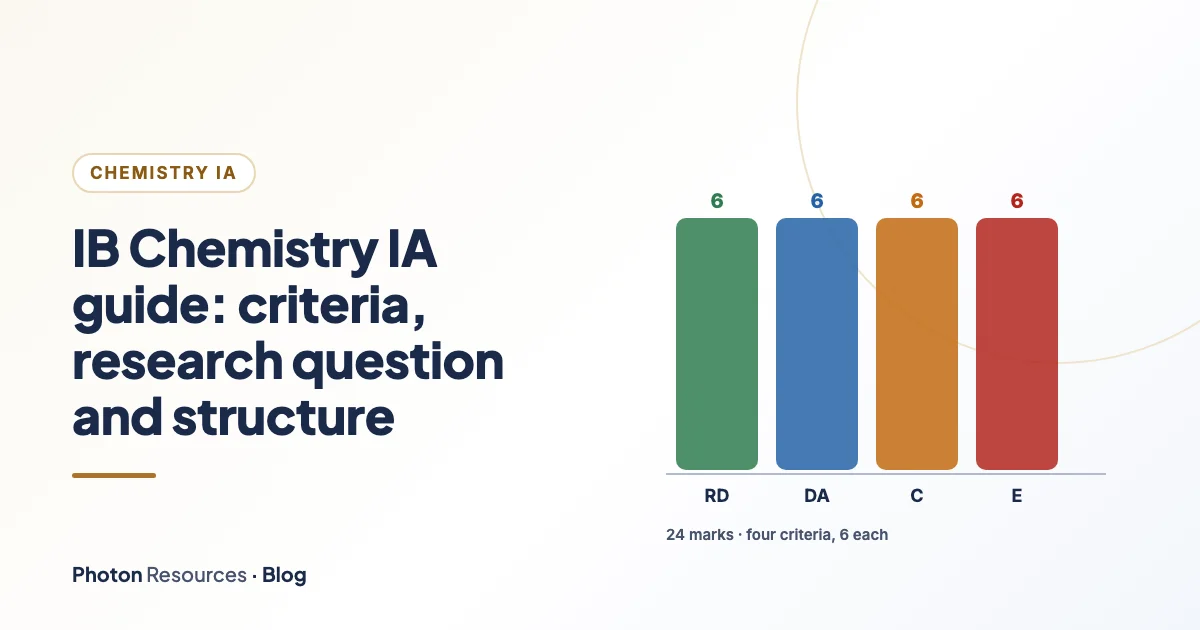
- 24 marks
- 3,000 words
- About 10 hours
- Research question
- Safety and titration tips
Chemistry IAs fail in a few predictable places. A titration average includes the rough titre. A literature value is quoted without saying which temperature it applies to. An energy experiment loses most of its heat to the room and the evaluation never mentions it. The fix is not more chemistry knowledge; it is knowing what the marker looks for and planning backwards from that.
Want ideas first? Go to 25 Chemistry IA topic guides. Already drafting? Use the checklist.
Browse 25 Chemistry IA topic guides → Each has a set-up diagram, a sample graph and a plan.
What the IB Chemistry IA is
The Chemistry IA is the one piece of coursework in the subject. You choose a question, gather quantitative data (in the lab, from a database, by simulation or by modelling), analyse it and write a report that concludes and evaluates. It is the same task and the same 24 marks at SL and HL.
| Fact | What to know |
|---|---|
| Weighting | 20% of your final Chemistry grade, at SL and at HL |
| Total marks | 24: four criteria of 6 marks each, the same at both levels |
| Time | About 10 hours, in and out of lessons |
| Length | 3,000 words of running prose at most. Charts, diagrams, data tables, equations, calculations and references do not count |
| Group work | Optional, up to three students, but your investigation, data and report are your own |
| Data | Must be quantitative. Lab work, fieldwork, spreadsheet modelling, a database or a simulation all qualify |
| Teacher help | Your teacher reads one draft and gives advice, but does not edit it |
Tables and calculations sit outside the limit but prose does not, so an argument hidden in a table must still be written as sentences. Your report opens with your title, candidate code, any partner codes and the word count.
Group work: you may share equipment and a similar method, but each of you must change a different independent variable, measure a different dependent variable or use a different slice of shared data. Group reports and identical raw data are not allowed. Our IA and EE guide compares this with the Maths IA and the Extended Essay, and the IA & EE Coach gives feedback on a draft.
How the IB Chemistry IA is marked
All four criteria are worth the same, so a strong report is balanced. Half the marks (Conclusion and Evaluation) are decided after the experiment. Students who spend nine of ten hours collecting data have little left for them.
These are our own plain-words summaries, not the IB's wording. Your teacher has the official criteria and the final say, so read those alongside this guide.
Research design (6 marks)
Is your question focused, and could your method actually answer it? The marker looks for clear variables, controls chosen for chemical reasons, and enough data over a sensible range. Chemistry adds a layer: you must treat hazards, waste and the environment before you handle anything.
What moves it up
- Name the independent and dependent variable in the question, with the chemical system.
- Explain the chemistry behind your prediction: an equation, a rate law or an enthalpy cycle.
- Use at least five values over a wide range, each repeated, and make solutions accurately, stating masses, flask volumes and the resulting concentration.
- Give hazards for the actual chemicals at the actual concentrations, and what you did about each, plus disposal.
Common slips. A generic safety list copied from a worksheet; concentrations that span a factor of 1.5; controls such as temperature never monitored; no reason given for the apparatus.
Data analysis (6 marks)
Raw data should be clear, the processing correct, and uncertainties carried through. In chemistry this usually means burette, pipette, balance and thermometer uncertainties feeding a final value, then a graph that shows the trend.
What moves it up
- Record raw data with units and instrument uncertainties.
- Show one worked example per calculation (moles, concentration, enthalpy).
- In a titration, leave out the rough titre and show the concordant values you averaged.
- Graph a linear form where possible and find the gradient with its uncertainty.
- State significant figures consistent with your instruments.
Common slips. Uncertainties calculated for the burette and then ignored; units not converted (cm³ to dm³) before calculating; a titre average that includes the rough run; over-precise answers from a thermometer reading to 1 °C.
Conclusion (6 marks)
Answer your own question using your analysis, and compare the result with an accepted value or a model. The comparison has to take your uncertainty into account, and it has to state the conditions the accepted value applies to.
What moves it up
- Answer in terms of your data: the trend, the order, the value and its uncertainty.
- Compare with a data-book or theoretical value, naming the conditions, and judge agreement using your uncertainty.
- Link back to the chemistry in your background section.
- Stay inside the range you tested.
Common slips. A data-book number quoted without temperature or concentration; "the hypothesis was supported" with no number; a conclusion that merely repeats the method.
Evaluation (6 marks)
Be honest and specific about what limited your result. In chemistry, heat loss, impure or old reagents, incomplete reactions and endpoint judgement are common real weaknesses, but they only count if you show them in your data.
What moves it up
- Tie each weakness to something visible: scatter, a plateau, a temperature that never reached the expected value.
- Rank them by effect on the result and say whether each is random or systematic.
- Make each improvement answer a named weakness (a lid, a polystyrene cup, a pH meter in place of an indicator).
- Suggest an extension that tests the next question.
Common slips. "Impure reagents" or "human error" with no evidence; a long list with no ranking; "use better equipment".
From my classes
Check the heat first
At Photon Academy I tell students that in almost any energy experiment, heat loss is the biggest weakness, so plan how you will estimate its size before you start. A single extra run with a lid, or a cooling curve to extrapolate, turns a vague complaint into evidence.
See how IB grade boundaries work for how these marks feed your grade, and IB command terms for what "evaluate" and "justify" ask of you.
IB Chemistry IA research question examples
A weak research question is a topic with a question mark. The test: can a stranger name the independent variable, the dependent variable and the chemical system from your question alone? If not, follow the funnel below.
| Too vague | Better (ours, for illustration) | Why it improves |
|---|---|---|
| Acids and metals | How does the concentration of hydrochloric acid (0.2 to 1.0 mol dm⁻³) affect the volume of hydrogen from magnesium ribbon in the first 60 s? | Names the system, both variables and a range. |
| Energy from fuels | How does the number of carbon atoms in a primary alcohol (methanol to pentan-1-ol) affect the enthalpy of combustion per mole? | A trend across a homologous series you can compare with data-book values. |
| Vitamin C in juice | How does storing orange juice at 4, 20 and 35 °C for seven days affect its vitamin C content, measured by titration? | Clear conditions, a standard method and a measurable outcome. |
| Buffers | How does the starting concentration of an ethanoic acid buffer affect the pH change per cm³ of 0.10 mol dm⁻³ NaOH added? | A buffer-capacity idea turned into a measurable gradient. |
Three checks before you commit. Can I vary it widely? Five or more values, each repeated. Can I check the chemistry? Pick a system with a known equation, enthalpy change or rate law, so the conclusion has something to be compared with. Can I do it safely with what the lab has? Run a pilot and ask your teacher early. A twist on a standard practical, such as a different indicator, fuel, mineral or sample from home, is what makes the report yours.
IB Chemistry IA ideas
Good Chemistry IA ideas combine a clean method with a twist of your own. Three from our explorer, each with a set-up diagram, a sample graph and a step-by-step plan:
- The vitamin C clock: finding activation energy: a colour-change reaction with a clear Arrhenius analysis.
- Hess's law with copper(II) sulfate hydration: an energy cycle where heat loss is a real, measurable problem.
- Iodine and propanone: which reactant sets the rate?: a classic kinetics experiment with a surprising answer.
That is three of 25. The Chemistry IA topic explorer holds the rest, each with a "make it yours" twist so you do not hand in the same report as everyone else.
IB Chemistry IA structure and word count
The IB does not prescribe headings, but a structure that follows the criteria makes it easy for the marker to find evidence. Because only prose counts towards 3,000 words, plan a budget before you write. A sensible split is below.
| Section | Budget | What goes in it |
|---|---|---|
| Question and background | About 400 | The question, the chemistry, the equation or rate law, and a prediction. |
| Method | About 550 | Variables and how each is changed, measured or controlled; how solutions were made; hazards with actions, waste and environment; a labelled diagram. |
| Analysis | About 650 | Raw tables (outside the count), one worked example, uncertainties, graph, and the result with its uncertainty described in words. |
| Conclusion | About 550 | Your answer, comparison with an accepted value under stated conditions. |
| Evaluation | About 700 | Ranked weaknesses tied to the data, random or systematic, with specific improvements and an extension. |
Charts, tables, equations and calculations do not count towards the 3,000 words, but prose does, so do not hide your reasoning in a table. Reference all sources, including data-book values.
IB Chemistry IA timeline: from idea to final report
Ten hours is not long, so spread it across weeks and protect the later stages. A realistic plan is below.
- Weeks 1 to 2. Choose a system, run a ten-minute pilot to fix concentrations and times, and write the question with a prediction and a risk assessment.
- Weeks 3 to 4. Make solutions carefully, repeat runs and log room temperature. Keep raw data safe.
- Week 5. Convert units, process with uncertainties, plot a linear form and find the gradient.
- Weeks 6 to 7. Write the whole report, then use your teacher's one round of feedback after checking it against the criteria.
- Week 8. Check word count, references, significant figures and axis labels.
Another thing I see often: students settle the endpoint with the eye and then claim a precision no eye has. State how you recognised it, and let that shape the uncertainty you claim.
IB Chemistry IA checklist before you submit
- The question names both variables and the chemical system.
- At least five values over a wide range, each repeated, with controls explained.
- Solutions made accurately, with masses, volumes and concentrations stated.
- Hazards, actions, disposal and environmental points covered for each chemical.
- Raw data with units and uncertainties; one worked example per calculation; units converted.
- A suitable graph with labelled axes and error bars, and a result with its uncertainty.
- Conclusion compares with an accepted value, stating its conditions, using your uncertainty.
- Evaluation with ranked, specific weaknesses linked to the data and matching improvements.
- Under 3,000 words of prose, with title, candidate code and word count at the start.
- All sources referenced and the work entirely your own.
The IB treats work written or heavily edited by someone else, or by an AI tool, as not yours. Feedback is fine; writing is not. If you use a tool for ideas or checking, say so and cite it.
Where to go next
Official background is on the IB Diploma Programme page, and your teacher has the current criteria. For reference values with stated conditions, the NIST Chemistry WebBook is reliable, and the Royal Society of Chemistry education site has tested practical ideas.
On this site, see the annotated Chemistry data booklet, uncertainties and error bars (the method is the same in chemistry), and the Paper 1A and 1B guide. The full IA and EE guide compares all the IAs; siblings are the Physics, Biology and Math IA guides. Practise the content with the free Chemistry practice topics (HL and SL). If you are comparing courses, see IB Chemistry vs A Level.
6 Chemistry IA ideas to start with
- Ethanol and water: do the volumes really add up?
- Hydrogen's spectrum: pulling out the Rydberg constant
- Counting atoms: Avogadro's constant by electrolysis
- Real gases: how far from ideal?
- The ionic model vs real salts: where does it break?
- Bond length and strength by computer modelling
See all 25 in the Chemistry IA ideas explorer.
Feedback, never written for you
Check your draft with the IA & EE Coach
The IA & EE Coach reads your draft against the criteria and asks questions about the gaps. It never writes or rewrites any of it. Start from the Chemistry IA topic explorer if you still need an idea.