
Blog
IB Biology notes and study guide: how to revise by theme
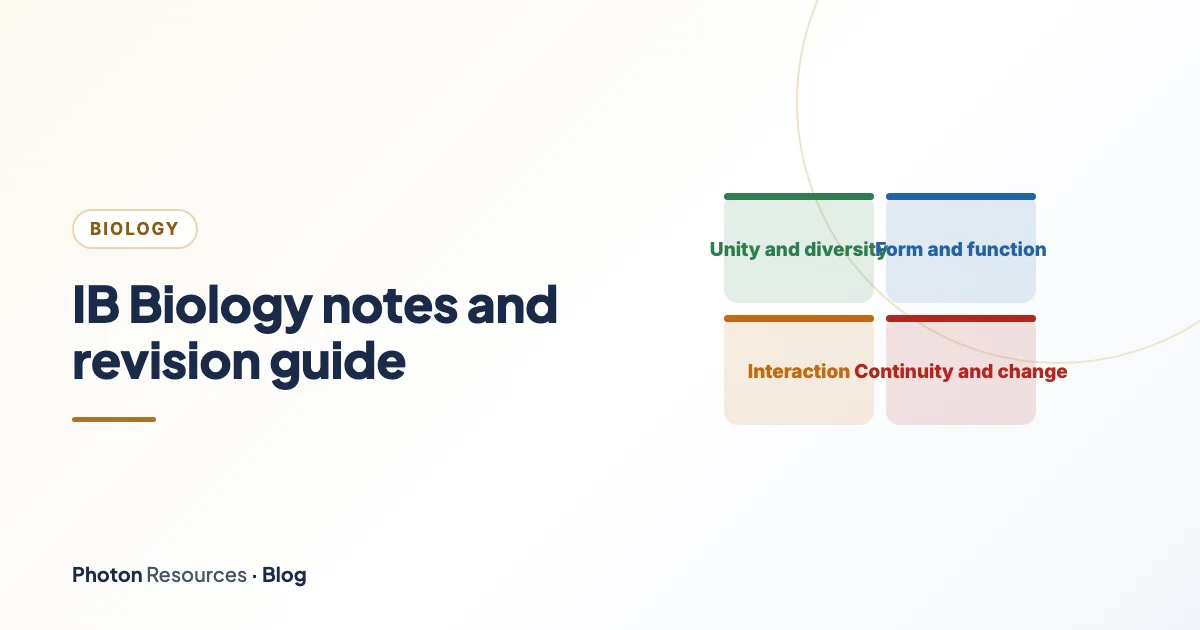
The 2025 IB Biology course is organised around four themes rather than a long list of unrelated topics. This guide shows how to build useful notes around that structure, how to revise actively instead of re-reading, and how to run a 10-week plan and the last two weeks before the exam.
By Ejaz Ahmad · 26 October 2026 · 10 min read
- Notes
- Active recall
- Four themes
- 10-week plan
Most students searching for IB Biology notes want one of two things: a place to read the content, or a method that makes the content stick. Notes alone rarely do the second job. What helps is a structure you can navigate, a way of testing yourself and a habit of connecting ideas across the course. This guide covers all three.
How the IB Biology course is organised: four themes and four levels
The course first assessed in 2025 groups the content into four themes, each studied across levels of biological organisation, from molecules up to ecosystems. The theme names below are the ones used in the IB's course. The topics we mention under each are examples to orient you, not the official list, so check the current subject guide for the exact content at your level.
| Theme | The big question it answers | Example ideas you will meet |
|---|---|---|
| Unity and diversity | What do living things share, and why are there so many kinds? | Water, nucleic acids, cell structure, diversity, classification, evolution |
| Form and function | How does structure suit a job? | Membranes, organelles, transport, gas exchange, organ systems |
| Interaction and interdependence | How do living things and their surroundings affect each other? | Enzymes, metabolism, respiration, photosynthesis, signalling, ecosystems |
| Continuity and change | How do living systems stay stable, and how do they change over time? | DNA and heredity, cell division, homeostasis, populations, natural selection |
Some topics sit comfortably under more than one theme. That overlap is deliberate, and it is the reason a topic-by-topic list of facts is a weak way to revise.
Because every theme runs from molecules to ecosystems, you can ask the same four questions at every level: what is it made of, how is it built, what does it interact with, and how does it change? Writing those four prompts at the top of a page is a quick way to stop notes becoming a wall of text.
How to build IB Biology notes that you will actually use
Good notes are short, structured and written in your own words. Copying a textbook is the slowest way to learn and the least effective.
- One page per sub-topic. If it does not fit on one page, you are copying rather than selecting.
- Use the same layout every time. A heading, a three-line summary, a labelled diagram, key terms with meanings, and a short list of "how could this be examined?".
- Write questions in the margin. Turn each fact into a question you could answer from memory later.
- Mark what you do not understand. A highlighted gap is more useful than a neat page that hides it.
- Keep a mistakes page. Every wrong answer from practice gets one line: what you wrote, what was right and why.
If you would rather start from finished notes and adapt them, the Photon Biology guidebook follows the course structure, and our IB cheatsheets collect the key results into quick reference pages. Use them as a skeleton and add your own examples and weak spots on top.
Active recall and spaced practice: the revision methods that work
Re-reading feels productive because the page looks familiar, but familiarity is not the same as being able to produce an answer under pressure. Active recall means closing the notes and retrieving the idea yourself.
- Blank-page recallPick a sub-topic, close the book and write or draw everything you remember in five minutes. Then compare and fill the gaps in a different colour.
- Question cardsPut a question on one side and the answer on the other. Include "explain why" cards, not only definitions.
- Space it outReturn to each topic after a day, then after about a week, then after a few weeks. The gaps are what make the memory stronger.
- Mix topicsAlternate between themes in one session. Exams do not arrive sorted by topic, so practise switching.
Diagrams, key terminology and command terms
Biology rewards precise vocabulary. Using the right word, such as naming the specific structure or process instead of saying "it moves", is often what separates a mark from no mark. Build a glossary for each theme, and write each definition in your own words before you check it.
Diagrams are worth learning to draw from memory: a membrane, a mitochondrion, a nephron, a food web, a nutrient cycle. Practise drawing quickly, with labels and a one-line note on what each part does. A diagram you can reproduce in two minutes is a source of both marks and explanations.
Finally, learn what the examiner is asking for. Verbs such as describe, explain, compare and evaluate each want a different answer shape. Our guide to IB command terms explains the common ones with examples, and the IB's own subject guide has the official list for Biology.
Common revision mistakes in IB Biology
Before adding more hours, check that the hours you already spend are pointed the right way. These are the habits we would look at first.
| Mistake | What it looks like | Fix |
|---|---|---|
| Passive reading | Re-reading notes or watching videos without writing anything down. | After each session, close everything and write what you remember. |
| Favourite-topic bias | Spending most of the time on topics you already enjoy. | Let the red-amber-green audit decide the order of work. |
| Memorising without applying | You can recite a process but stall when the question gives you new data. | Pair every topic with at least one unfamiliar data question. |
| Ignoring the mark scheme style | Long, accurate answers that miss the specific points a question is built around. | Compare your answers with the model answers in practice sets and note the missing points. |
| Cramming practicals last | Experimental design and data handling are left until the final week. | Do one data-handling task a week from the start. |
The fix for almost all of these is the same: make revision harder in the right way. If a session felt easy, you were probably recognising, not recalling.
Connecting ideas across themes so topics stop feeling separate
The marks that students find hardest are often the ones that cross topic boundaries. A data question on a pond might need photosynthesis, a food web and a population idea all at once. Practise linking on purpose.
| Link | Why it helps |
|---|---|
| Enzymes and homeostasis | Temperature and pH effects on enzymes explain why the body controls its internal conditions. |
| Membranes and transport | Structure explains which substances cross, and how fast. |
| DNA and natural selection | Variation from mutation and inheritance is the raw material of evolution. |
| Photosynthesis, respiration and ecosystems | Energy and matter flow connects the cell to the biosphere. |
A simple exercise: choose two sub-topics from different themes each week and write three sentences connecting them. It takes five minutes and builds the habit that extended-response questions reward.
Using practice questions and past-paper analysis to decide what to revise
Notes tell you what exists. Practice tells you what you can do. Use both, and let the results steer where your time goes.
- Start from the basics. Our Biology practice library runs from "Basics" up to "Challenge", so you can check you can handle a topic's fundamentals before you attempt a hard data question.
- Find the heavy topics. The HL Biology past-paper analysis and SL Biology past-paper analysis show which areas have carried the most marks, so you can weigh your effort sensibly. The method is explained in how we analyse IB past papers.
- Know the papers. Understanding how Paper 1A, 1B and Paper 2 reward different skills changes how you practise. Read how the IB Biology exam papers work early in your revision.
- Use your own investigation. The data handling you do in the internal assessment is also a rehearsal for Paper 1B. See the IB Biology IA guide.
A worked example of turning a topic into a revision cycle
Take enzymes as an example. On day one, make a one-page note: the idea of a catalyst, how structure fits function, and what temperature, pH and substrate concentration do to the rate. On day two, close the page and sketch a rate graph against temperature from memory, labelling the optimum and writing one sentence on why the rate drops beyond it. On day five, attempt a data question that gives you an unfamiliar enzyme and a table of rates, and describe the trend with numbers. A fortnight later, repeat the blank-page sketch. By then you have met the same idea four times in four different ways, which is what makes it durable.
A 10-week IB Biology revision plan
This outline assumes about eight to twelve weeks and can be stretched or squeezed. Adjust the order to match your school's teaching sequence and what you have already covered. Our revision plan by level gives a broader template that works across subjects.
| Weeks | Focus | What to do |
|---|---|---|
| 1 | Audit | List every sub-topic in the guide, rate each red, amber or green, and attempt a short mixed quiz to check your ratings. |
| 2 to 3 | Unity and diversity | Build one-page notes, then close the notes and test yourself. |
| 4 to 5 | Form and function | Learn and redraw key diagrams. Practise structure-to-function explanations. |
| 6 to 7 | Interaction and interdependence | Cover metabolism and ecosystems. Add data-based practice on rates and energy flow. |
| 8 to 9 | Continuity and change | Cover heredity, homeostasis and populations. Add genetics and statistics practice. |
| 10 | Mixed review | Timed mixed papers, then fix the weakest red areas from your audit. |
In every week, keep two short habits: a mistakes page update after each practice session, and one spaced review of an earlier theme. HL students should schedule the HL-only content alongside each theme instead of leaving it until the end.
What to do in the last two weeks before the exam
The final fortnight is for consolidation, not new material. The aim is to protect what you know and get faster at using it.
- Days 14 to 10Work through your mistakes page and your red topics. Redraw the key diagrams from memory.
- Days 9 to 5Sit timed sections of each paper type. Mark them strictly and log the causes of lost marks: knowledge, wording, units or time.
- Days 4 to 2Light recall only. Read your glossary, command terms and one-page summaries. Sort out equipment and exam logistics.
- The day beforeStop early. A rested brain recalls better than a tired one.
Set a realistic target by looking at the IB grade boundaries and trying your own marks in the IB grade calculator. It shows you how much a few extra marks on each paper can change the final grade, and it also reminds you that you do not need perfection to reach a strong result.
Free resources worth adding to your notes
Official documents come first: the IB publishes the subject guide, and you can start from the IB Diploma Programme page. For a free topic-by-topic reference written for IB students, BioNinja is widely used, and Khan Academy Biology offers short explanations of many core concepts. Always cross-check anything you copy against your subject guide, since content and emphasis can differ between courses.
If you are looking for structured teaching alongside your own revision, Photon Academy runs IB classes for several subjects.
Practise it
Turn your notes into marks
Pick the theme you are revising this week and test yourself on it with our practice questions, from the basics up to Challenge. Two topics in every course are free.
Photon Learning Studio is on the App Store for iPhone and iPad. Get the app