
Blog
IB Biology Paper 1 and Paper 2: how the exams work and how to prepare
In the IB Biology course first examined in 2025, Paper 1 has a multiple-choice part (1A) and a data-based part (1B), and Paper 2 holds the short-answer and extended-response questions. This guide explains what each paper tests, how SL and HL differ, how to pace yourself and how to practise.
By Ejaz Ahmad · 26 October 2026 · 9 min read
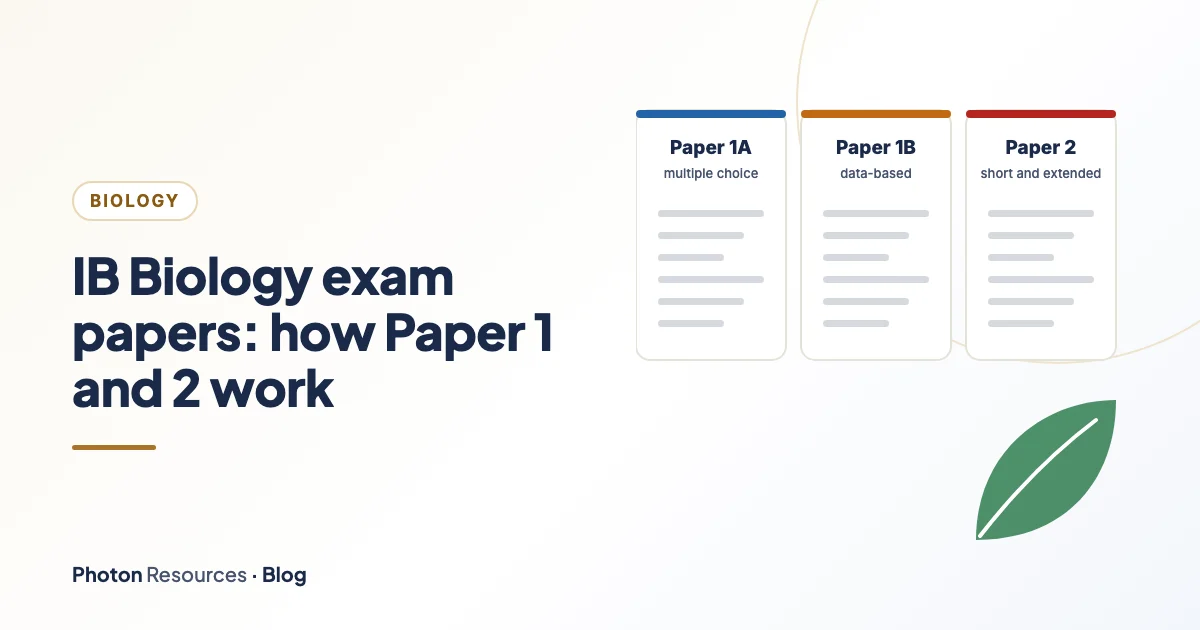
- Paper 1A
- Paper 1B
- Paper 2
- SL and HL
If you have older revision notes, or a sibling who sat IB Biology a few years ago, the exam you will face looks different. The current course replaced the old Paper 3 and its option topics, and it now asks you to work with unfamiliar data far more often than it asks you to recite a textbook. Knowing the shape of each paper before you start revising saves a lot of wasted effort.
The exam structure: Paper 1A, Paper 1B and Paper 2
The figures below are the commonly published outline for the course first assessed in 2025. We could not open the IB's own site to read the subject guide directly, so the durations and weightings come from study-resource summaries that agree with each other. Treat them as a guide and confirm them in the current Biology subject guide, which your teacher can share.
| Component | SL | HL | Weighting |
|---|---|---|---|
| Paper 1 (1A and 1B, one session) | 1 h 30 | 2 h | 36% |
| Paper 1A: multiple choice | 30 questions | 40 questions | inside Paper 1 |
| Paper 1B: data-based questions | the rest of Paper 1 | the rest of Paper 1 | inside Paper 1 |
| Paper 2: short answer and extended response | 1 h 30 | 2 h 30 | 44% |
| Internal assessment | Scientific investigation | 20% | |
We have deliberately left out the exact mark totals for Paper 1B and Paper 2, and how marks are split between the sections of Paper 2, because we could not confirm them from the IB itself. Your subject guide and the specimen papers give them precisely.
Together the two external papers account for 80% of the final grade, and the scientific investigation covers the other 20%. If you are working on that part now, our IB Biology IA guide walks through it. To see how your paper marks and internal mark combine into a final grade, use the IB grade calculator, and read how grade boundaries work before you panic about a single paper.
What each paper tests
Paper 1A: breadth and precision
Multiple choice samples the whole syllabus quickly. A good item checks whether you can apply an idea, not just recall it: reading a small diagram, comparing two processes, or spotting which statement about a graph is supported. Because one paper has to touch many topics, you cannot predict which ones appear, so broad and accurate knowledge matters most here.
Paper 1B: data in, reasoning out
This part gives you experimental data, a figure or the description of an investigation, and asks you to handle it. Expect to read values from graphs, process numbers, link a result back to the biology and judge whether a method supports a conclusion. The skills are the same ones you practise in your own investigation, which is why students who run careful practicals tend to find it easier.
Paper 2: explanation and extended writing
Paper 2 mixes structured short-answer questions with longer extended-response questions. Marks reward specific biology written in connected sentences: a named structure, what it does and why that matters for the organism. The longer questions also reward a clear plan, because a well-organised answer is easier to mark generously than a rambling one.
How SL and HL differ on these papers
The three-paper pattern is identical at both levels. HL sits longer papers, includes extra HL-only content and sets more demanding versions of the same skills. Pacing is nearly the same: for Paper 1, 90 minutes at SL and 120 minutes at HL work out to about the same time per mark if you use the mark totals printed on your paper. The takeaway is that HL does not give you extra thinking time per question. You need the same speed on routine steps, plus the stamina to hold that speed for longer.
If you are unsure which topics carry the most weight at your level, our past-paper analyses are built for exactly that question: see HL Biology past-paper analysis and SL Biology past-paper analysis.
Time pressure and pacing: how to plan each paper
Most lost marks on these papers come from time, not ignorance. A simple plan helps you avoid spending ten minutes on one item.
- Set a pace for 1AAim for roughly a minute on a routine multiple-choice item. If you are past two minutes, mark your best guess and move on.
- Bank time for 1BThe data questions take longer per mark than multiple choice. Whatever you save on 1A is what you spend on 1B, so do not rush the part that is easy to lose marks on.
- Budget Paper 2 by marksWork out minutes per mark from the paper's printed total and allow a little less than that for short answers, so you have a reserve for the extended response.
- Never leave a blankAn empty answer cannot earn marks. Write something sensible, even if it is a partial idea.
Practise pacing under a timer from the start, not only in the final month. A student who is accurate but slow needs a different fix from one who is fast but careless, and you will only know which you are by timing yourself.
How to approach data-based questions: graphs, tables and experimental design
This is where Biology differs most from a pure recall subject. Use the same routine every time so that you are never starting from nothing.
- Read the axes and units first. Before you look at the shape, say aloud what is on each axis and what the units are. Half of all misreadings start by skipping this.
- Describe with numbers. "Rate increases" is weak. "Rate rises from about 2 to about 9 units between 10 and 30 degrees, then falls" shows you read the graph and gives the examiner something to credit.
- Identify variables. Name the independent variable, the dependent variable and one or two things held constant, and say why holding them constant matters.
- Link the result to a mechanism. After the trend, give the biological reason. If a rate falls at high temperature, say what happens to the enzyme, not just that the rate falls.
- Evaluate the method specifically. Name a real weakness, such as a small sample, a poorly controlled temperature or readings taken by eye, say how it would shift the results, and propose a fix that matches it.
Error bars and what they let you claim
Error bars show how spread out or uncertain the data are. If the bars of two groups overlap a lot, the difference between the means may not be meaningful, so be careful with words like "significantly higher". If the bars are small and well separated, you can make a stronger statement. Practise saying which of the two situations a graph shows before you write your conclusion, and check which quantity the figure's caption says the bars represent.
Statistics you should be comfortable with
Be ready to calculate or interpret a mean and a spread, a percentage change, and a rate. Know in broad terms what a standard deviation tells you, and what a statistical test is for. Which specific tests and techniques are required is set out in the subject guide, so check that list rather than assuming. Our guide to uncertainties and error was written for physics, but the habits about precision and propagation transfer well to Biology practicals.
Common mark-losing habits to fix now
| Habit | Why it costs marks | Better habit |
|---|---|---|
| Describing the whole graph vaguely | Nothing specific for the examiner to credit. | Quote values and name the trend and its turning point. |
| "Human error" or "repeat more" | Names no weakness and no effect on the result. | State the specific flaw, its effect and a matching fix. |
| Answering a different command term | Writing a description when the question says explain. | Underline the command term first. See IB command terms explained. |
| Skipping the link between structure and function | States the feature but not why it helps. | Use a "so" in every sentence: feature, so effect. |
| Dropping units and sensible precision | Correct working loses the final mark. | Check the unit and rounding on the last line of every calculation. |
| Leaving the extended response to the end | Rushed, unplanned writing. | Reserve a block of time and jot a three-point plan first. |
Our classes at Photon Academy see the same pattern across subjects: strong students lose marks on wording and units far more often than on understanding.
How to practise each part of the exam
Match the practice to the paper, because the skills are different.
| Part | Best practice | Common trap |
|---|---|---|
| Paper 1A | Short timed sets across mixed topics, with every wrong answer traced to the step that went wrong. | Revising one topic at a time only, so mixed sets feel unfamiliar. |
| Paper 1B | One new data set a day: read, describe with numbers, explain, evaluate. | Describing the figure instead of using it. |
| Paper 2 | Write full answers under time, then mark yourself against the command term. | Knowing the content but writing it in loose, unconnected sentences. |
Our Biology practice library is organised as "Basics to Challenge", so you can start with the fundamentals of a topic and move up to harder, exam-style data questions when you can finish a set on time. Two topics in every course are free to try. If you want structured reading to go with the questions, the Photon Biology guidebook follows the same approach, and the HL Biology and SL Biology pages collect the resources for each level.
A simple weekly plan for Paper 1 and Paper 2
- Mon and WedA timed Paper 1A style set of 10 to 15 questions drawn from mixed topics. Review every error and note the cause.
- ThuOne Paper 1B style data set. Describe with numbers, explain the biology, then evaluate the method.
- SatOne Paper 2 style question in exam conditions. Plan for two minutes, write, then mark it line by line against the command term.
- SunFifteen minutes on terminology and diagrams that you got wrong during the week.
Keep the weekly rhythm going and increase the difficulty rather than the volume. If you are building a plan for the whole stretch before the exam, our revision plan by level shows how to space it, and the grade boundaries page helps you set a realistic target for each paper.
Where to check the official details
The IB sets the assessment outline, command terms and required skills in the subject guide, so for exact marks, sections and permitted equipment use that document rather than any third-party summary, including this one. Start from the IB Diploma Programme page and ask your teacher for the current Biology guide. For background reading that deepens your understanding of the content, BioNinja is a long-established free IB Biology site, and Khan Academy Biology explains many core ideas with short videos.
Practise it
Train Paper 1A, 1B and Paper 2 at the right level
Start with the basics of a topic, move to exam-style questions once you can finish a set on time, and use the Challenge level to stretch. Two topics in every course are free.
Photon Learning Studio is on the App Store for iPhone and iPad. Get the app