
Blog
IB Maths marks explained: M1, A1, R1, FT and AG
IB Maths is marked line by line, not just on the final answer. Method marks, accuracy marks and reasoning marks each reward a different thing, and knowing which is which changes how you set out your working. This guide explains the codes in plain English, with original worked examples that show which lines earn M1 and A1.
By Ejaz Ahmad · 26 October 2026 · 10 min read
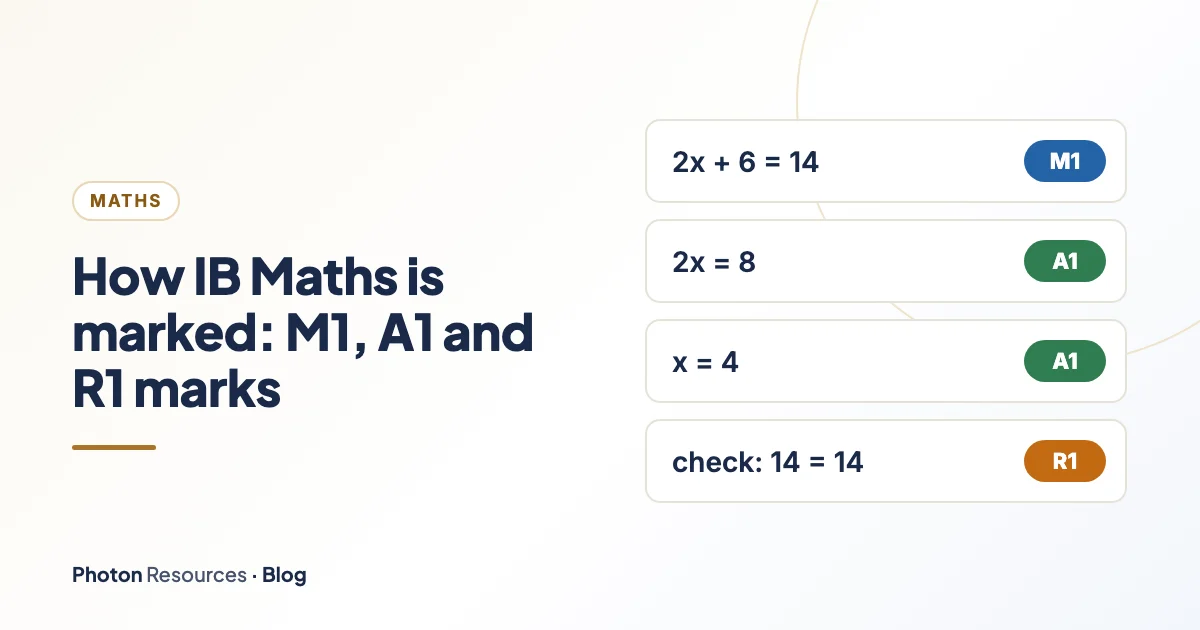
How IB Maths is marked: marks for working, not just answers
Most students think of a maths exam as right or wrong. IB examiners do not. Each question carries a number of marks, and those marks are attached to specific steps. An answer with a small slip in the middle can still collect most of the marks, and a correct answer with no working can collect fewer than you expect.
The IB uses a set of codes in its marking guidance for examiners. I teach IB Maths and Physics, and I mark practice work with the same logic every week, so this page is my plain-English summary of how the codes work. It is not the IB's wording. The conventions can be refined between sessions, so confirm the details against the guidance your teacher has from the IB, and see the IB Diploma Programme page for the official source.
- Marks sit on lines. Think of each line of your solution as a possible mark.
- Working is evidence. The examiner can only credit what is written down.
- Some marks depend on others. An accuracy mark usually needs the method mark before it.
M1, A1, R1: what the mark codes mean
| Code | What it rewards | What to write |
|---|---|---|
| M1 | A method mark: an attempt to use a valid method, even if the arithmetic goes wrong. | The formula, the substitution, or the equation you set up. |
| A1 | An accuracy mark: a correct answer or result at that stage. It usually depends on the method mark before it. | The correct value, with the form the question asks for. |
| R1 | A reasoning mark: a clear statement of why something is true. | A short sentence or a justified line, such as "since the discriminant is negative, there are no real roots". |
| AG | Answer given. The final line is printed in the question, so no mark is awarded for reaching it. | All the steps that lead to it, with none skipped. |
| FT | Follow through: credit for using an earlier wrong answer correctly in a later part. | Visible working that uses your earlier value. |
Brackets such as (M1) or (A1) usually indicate that the mark can be given when the step is implied by correct later working. Do not rely on that, though. Writing the step costs you five seconds, and an implied step is a gamble.
Two further points are worth knowing. First, marks for answers with no working at all are limited, so a bare number can score less than the marks printed beside the question. Second, examiners are told not to take marks away twice for the same error, which is what follow-through protects. Read on for both.
Worked example 1: banking M1 and A1 across three parts
This is an original question, written for this page. It is not an IB question.
Original question
The function is f(x) = x3 − 6x2 + 5.
(a) Find f′(x).
(b) Find the values of x where f′(x) = 0.
(c) Hence find the value of f at the larger of these two values of x.
Here is how I would set the solution out, with the marks a mark scheme of this style would attach. The mark labels are my own illustration of the pattern.
| Line of working | Mark | Why |
|---|---|---|
| (a) f′(x) = 3x2 − 12x | M1 A1 | M1 for differentiating with at least one term correct. A1 for the whole derivative. |
| (b) 3x2 − 12x = 0 | M1 | Setting the derivative equal to zero is the method. |
| 3x(x − 4) = 0 | (M1) | A valid way to solve, shown on paper. |
| x = 0 or x = 4 | A1 | Both values, correct. |
| (c) f(4) = 43 − 6(4)2 + 5 | M1 | Using the larger value from part (b), as "hence" asks. |
| = 64 − 96 + 5 = −27 | A1 | The correct value. |
Notice what each mark needs. The M1 in (c) is for the substitution line, written out. If you only write "−27", you may still be credited, but you have given the examiner no evidence if it were wrong, and a single arithmetic slip would then cost every mark.
Follow-through (FT): getting credit after an early error
Suppose a student slips in part (a) of the example above and writes f′(x) = 3x2 − 12 instead. Their part (a) loses the A1, but they keep the M1 for differentiating. Now see what happens next.
- Part (b): 3x2 − 12 = 0 gives x = ±2. The method is still valid, so the M1 is still available, and the answers can be credited as a follow-through (A1 FT) because they come correctly from the student's own earlier line.
- Part (c): the larger value is x = 2, so f(2) = 8 − 24 + 5 = −11. The M1 is available for the substitution, and an A1 FT for the value, provided the working is shown.
The student who writes the working scores most of the marks despite one early slip. The student who writes only "−11" has nothing for the examiner to follow. FT only works when your working is visible. Also note that the question must remain a fair test of the same skill. If your wrong answer makes the later part much easier, the credit available can be reduced, so do not count on full marks after an error.
A practical lesson follows. If you get an odd result early, such as a negative length or a probability above 1, say so in one line and carry on with your value. You keep follow-through, and you show the examiner you spotted it.
"Show that" and AG: when the answer is given to you
A "show that" question gives the final result in the stem. Because you cannot lose the answer, the marks sit entirely in the steps between the start and the end, and an answer-given line itself is not awarded a mark. Nothing in your working may be skipped.
Original question
A rectangle has a perimeter of 20 cm. One side has length x cm. Show that the area, A cm2, is given by A = x(10 − x).
| Line of working | Mark |
|---|---|
| Let the other side be y. Then 2x + 2y = 20 | M1 |
| y = 10 − x | A1 |
| A = xy = x(10 − x) | AG |
Two habits protect these marks. First, write the final expression exactly as the question prints it, as a last line, so the examiner can see you arrived there honestly. Second, never work backwards from the given answer and then claim to have found it. If a sign or a bracket does not quite fit, it is better to find your slip than to fudge the last line.
What "hence" and "hence or otherwise" mean for your working
When a question says "hence", it asks you to use the result of the previous part. Solving the whole problem from scratch another way may earn nothing, or less credit, because you have not done what was asked. In example 1, part (c) said "hence", which is why the substitution used the value from part (b).
"Hence or otherwise" gives you a choice. You can use the earlier result, which is usually the quicker route, or any valid method. When you see "hence", look back one part first, and check whether the answer you need is already on the page.
Rounding, significant figures and units
Accuracy marks have rules of their own, and the exam papers set out the general expectation: unless a question says otherwise, give a non-exact answer to three significant figures. Check the instructions on your paper and in your course materials, because the detail is yours to confirm.
- Keep exact values as long as you can. Carry fractions, surds or the full calculator value through the working, and round once, at the end.
- Do not round early. Rounding in the middle can push a later answer into the wrong third significant figure.
- Exact answers are fine. If an exact answer such as 3√2 comes out, you may write it exactly and then give the decimal as well. Where the question asks for an exact value, give only that.
- Write the unit. A real-world answer such as an area, a speed or a sum of money needs its unit, such as cm2, m s-1 or dollars, in the final line. Units are a quiet source of lost marks in context questions.
- Check reasonableness. A negative length or a probability of 1.4 signals an error before you move on.
Worked example 2: using the GDC and showing the line you typed
On a calculator paper, the GDC can do the equation-solving, but the mark scheme still wants to see your method. Our IB Maths GDC guide covers the skills; here is how they look on the page.
Original question
The mass of a sample, M grams, after t hours is modelled by M = 3e0.4t. Find the time when the mass reaches 50 grams. Give your answer to 3 significant figures.
| Line of working | Mark | Why |
|---|---|---|
| 3e0.4t = 50 | M1 | Setting up the equation from the model. |
| Graph y = 3e0.4x and y = 50; intersection at x = 7.0335… | (M1) | The GDC method, described, or an algebraic route. |
| t = 7.03 hours | A1 | Correct value, 3 s.f., with the unit. |
The line "graph y = 3e0.4x and y = 50; intersection at x = 7.0335" is what I mean by showing the line you typed. It tells the examiner what you did, so a correct method earns credit even if you misread the screen. A bare "7.03" gives them nothing to check. The same answer by algebra, t = ln(50/3) ÷ 0.4, shows the method just as well.
Two cautions. Do not copy a whole screen of the calculator. Write the equation or the function that you entered, and the value you read off. And never use the rounded 7.03 in a later calculation. Store the full value in the GDC memory.
How this changes your exam technique
Once you see marks as attached to lines, a few habits follow naturally.
- Write the setup line firstName the formula or write the equation before you calculate. That is where the M1 lives.
- Show one line per ideaEach step that could earn a mark gets its own line. Do not compress three steps into one.
- Never leave a blankAn attempt at a method can score. A blank cannot.
- Cross out only when you have replacedDo not delete working you have not replaced. A struck-out start can still be credited if nothing better stands in its place.
- Check the command word and the mark countA 4-mark question wants about four credit-worthy lines. Our guide to IB command terms covers the words that set the shape of your answer.
Practising with mark schemes in mind
The best way to learn the codes is to mark your own work. After a practice question, take a different colour and write M1 or A1 beside each line that deserves one. Where you cannot find a line to tag, that is a missing step. Then add the lost marks to a short log, by type: method not shown, early rounding, unit missing, "hence" ignored.
- Work through the free practice questions and mark them by line.
- See where marks cluster in your course with the past-paper analysis for AA HL, AA SL, AI HL or AI SL.
- Keep the cheatsheets beside you for the formulas, so working time goes on method, not recall.
- For a book that sets out worked solutions with the marks shown, see the Photon Guidebook for Maths AA HL.
- To see what the marks add up to, use the IB grade calculator and read the grade boundaries.
If you are planning the months before the exams, our IB revision plan by level fits mark-aware practice into a weekly routine. And for a school-side view, Photon Academy teaches these habits in class.
Practise it
Practise the working, not just the answers
Photon practice questions come with worked solutions that show where each method and accuracy mark is earned. Start with the free topics, and mark your own lines as you go.
Photon Learning Studio is on the App Store for iPhone and iPad. Get the app