
Blog
IB Physics exam papers: Paper 1A, Paper 1B and Paper 2 explained
The IB Physics course first examined in 2025 has three external papers: a multiple-choice Paper 1A, a data-based Paper 1B and a written Paper 2. This guide explains what each one rewards, how SL and HL differ, how to pace the time, how to attack data and graph questions, and how to practise for each.
By Ejaz Ahmad · 26 October 2026 · 10 min read
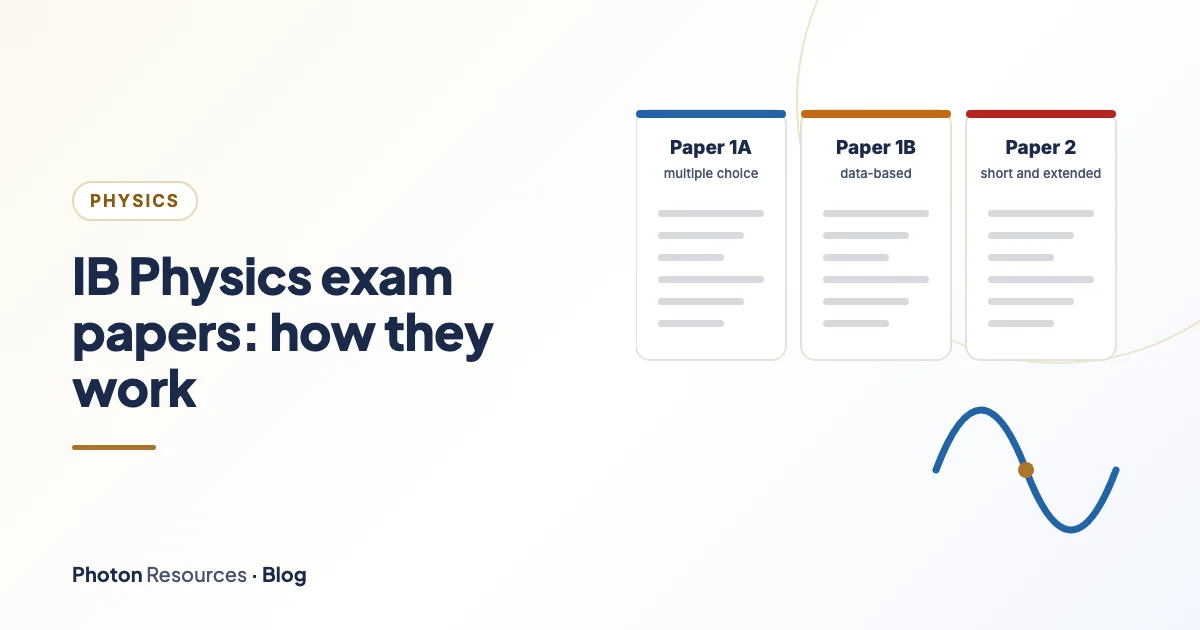
- Paper 1A
- Paper 1B
- Paper 2
- SL and HL
If your older cousin or last year's notes talk about "Paper 1, Paper 2 and Paper 3" in IB Physics, those notes describe the previous course. In the course first assessed in 2025 the option paper is gone, the old Paper 1 has been split into two parts, and the data booklet is allowed in the papers. The new layout changes how you should practise, because each part rewards a different skill.
I teach IB Physics HL and SL every week, and the most common problem I see is students who revise by reading notes, then meet a data set on Paper 1B and have no habit for handling one. This page is the map I give them. It is a summary in my own words. For the exact marks, question counts and rules, always check the current Physics subject guide on the IB website or ask your teacher, because the IB can adjust details.
How the IB Physics exam papers are put together
Three external parts carry 80% of your final grade. The remaining 20% is the internal scientific investigation, which your teacher marks and the IB moderates. Our Physics IA guide covers that side.
| Part | Format | Weighting | Time |
|---|---|---|---|
| Paper 1A | Multiple choice, sat together with 1B as Paper 1 | 36% for Paper 1 (SL and HL) | SL 1 h 30 min, HL 2 h for Paper 1 as a whole |
| Paper 1B | Data-based questions built around experiments and results | ||
| Paper 2 | Short-answer and extended-response questions | 44% | SL 1 h 30 min, HL 2 h 30 min |
| Internal assessment | Your own scientific investigation | 20% | Done during the course |
The weightings and timings above match the IB's published subject brief and exam schedules for this course. On marks, the specimen HL Paper 1 is worth 60 marks, of which Paper 1B is 20, which leaves 40 multiple-choice questions in Paper 1A. I have not listed the SL multiple-choice count or the Paper 2 mark totals here, because I could not confirm them against the IB's own documents while writing. Open the subject guide or the specimen papers your teacher has, and write the numbers on the front of your revision folder. You will plan your time better when you know them.
One more structural point. Both Paper 1 and Paper 2 allow the Physics data booklet. It is a reference document, not a memory aid, and Paper 1B in particular is written on the assumption that you will use it. Our guide to using the IB data booklets goes through how to work with it under time pressure.
SL versus HL: what actually changes in the papers
The papers share a format at both levels. What changes is length, depth and the amount of material you must cover.
- Time and length. HL candidates get more time for each paper and answer more questions. The time per question is not very different, so the pace feels similar.
- Content. HL includes extra material in several themes, and HL-only parts can appear in all three papers. SL students will not see those questions.
- Difficulty ceiling. HL questions go further in multi-step reasoning and in how much you must combine from different topics. A SL question usually stops one step earlier.
- Same skills. Handling data, graphs, units and uncertainties matters equally at both levels.
To see which topics carry the most marks at your level, our HL Physics past-paper analysis and SL Physics past-paper analysis show where past marks have clustered. Use them to decide the order of revision, not to guess the next paper.
Paper 1A: multiple choice under time pressure
Paper 1A is a bank of single-answer questions. The marks per question are small and equal, so one stubborn question is never worth the time it eats. What it tests is breadth: can you recognise the right idea, do a short calculation cleanly, and avoid the trap built into the wrong options?
How the wrong options are built
Distractors are not random. Each wrong option usually matches a typical slip: forgetting to square a quantity, using the diameter as the radius, missing a factor of two, mixing up a force with a field strength, or leaving a quantity in grams or centimetres. If you solve the question first and then look for your answer, you are using the distractors as a check. If you read the options first, you are inviting them to steer you.
Pacing for Paper 1A
Aim for a first pass through every question with a firm limit per item. A common method:
- First passAnswer what you can in well under two minutes per question. Mark the rest on the question paper with a clear flag that you will remember.
- Second passReturn to the flagged items. Estimate, eliminate, and commit to an answer. Never leave a blank, because there is no negative marking on a multiple-choice question.
- Final checkUse the last few minutes to check units and powers of ten on any question where the options were close to each other in size.
Paper 1B: data-based questions in Physics
Paper 1B is the part that surprises students. It presents experimental situations, tables, graphs and short descriptions of a method, and asks you to process, interpret and evaluate. The physics is usually from the syllabus, but the questions are about handling evidence, the same skills you use in the internal assessment.
A reliable method for every data question
- Read the setup firstIdentify the independent variable, the dependent variable and the controlled variables. Note units and the instrument resolution if given.
- Decide what the graph should showBefore using any number, ask what a straight line would mean. If a model says T2 depends on length, the gradient is a certain combination of constants. Knowing that tells you whether a plot is linear and what its gradient represents.
- ProcessWork out means, ratios, percentage changes or gradients, and keep extra digits until the final line.
- InterpretSay what the result means for the physics, not just what the number is. Compare it with a known value or with the prediction of the model.
- EvaluateName one specific limitation, say which way it would push the result, and suggest a fix that targets it.
Worked pattern
A mass on a spring
Suppose a question gives the period of oscillation for several masses on one spring, and asks you to find the spring constant from a graph. A good answer thinks first: for this model the period squared should be proportional to the mass, so plot T2 against m. The gradient then equals a fixed multiple of one over the spring constant. Read the gradient from two points far apart on the line, convert the units, rearrange for the spring constant, and compare it with any value in the question. If the line misses the origin, say what that suggests, such as the spring itself having mass.
Uncertainties and graph questions
Expect Paper 1B to ask for an uncertainty, an error bar interpretation or a comparison of a result with a stated value. You need three habits: add absolute uncertainties for sums, add percentage uncertainties for products and quotients, and multiply the percentage uncertainty by the power for powers. The steepest and shallowest line method gives the uncertainty in a gradient. We work all of these with numbers in uncertainties in IB Physics: error bars, gradients and propagation. Read that page before you start timed Paper 1B practice, because speed on these questions comes from having the rules automatic.
Two graph slips are worth singling out. First, choosing data points for the gradient triangle instead of points on the line, and choosing them too close together. Second, forgetting that an axis label includes a unit, so a gradient carries a unit too, built from the units of both axes.
What "evaluate" looks like here
Weak: "There could be human error, so repeat the experiment." Strong: "The stopwatch was started by hand, so each time is about a few tenths of a second too long. Over a short period this is a large fraction of the reading, so the period is overestimated and the calculated gravitational field strength is too low. Timing ten oscillations and dividing reduces this fractional error." Specific cause, direction of the effect, targeted fix. Our guide to IB command terms covers how each verb shapes the answer.
Paper 2: written reasoning and extended response
Paper 2 is where your explanations are marked. Questions run from short calculations to multi-part problems and finish with extended-response questions that may draw on more than one theme. Because it is the largest paper by weighting, it deserves the largest share of your revision time.
- Show the physics before the algebra. Name the law or principle, write the equation in symbols, substitute with units, then give the answer. Method marks are often available even when the final value is wrong.
- Link cause and effect in one sentence. "The net force is zero, so the acceleration is zero, so the speed stays constant" earns more than three separate true statements.
- Use the marks as a guide to length. Two marks means two distinct points. Don't write a paragraph for one mark, and don't write one line for four.
- Carry values forward carefully. If part (a) feeds part (b), keep the unrounded value on your calculator. A rounded intermediate answer can shift a final significant figure.
- Sketch a free-body or circuit diagram when a question has more than two moving parts. It costs thirty seconds and stops sign and direction errors.
Time management across the whole exam
Because Paper 1 and Paper 2 are sat on separate occasions, you can plan them separately. The skill is the same: protect your final minutes. Leaving ten minutes at the end of Paper 2 for the longest unfinished question, or for a unit-and-sign check on calculations, pays off more reliably than squeezing in one more minute per earlier question.
The habits that cost the most marks
- Unit slips. Centimetres used as metres, grams as kilograms, minutes as seconds. Convert at the start, not the end.
- Wrong form of an equation. Using a formula designed for a different situation, such as constant acceleration on a problem where the force changes. Say why the equation applies.
- Radius versus diameter, and squaring or cubing a quantity at the wrong stage.
- Calculator in the wrong mode. Degrees versus radians has sunk many wave and circular-motion answers.
- Too many or too few significant figures. Match the precision of the data.
- Describing a graph instead of using it. Say what the gradient or intercept means for the physics.
- Vague evaluation. "Human error" and "more repeats" score nothing on their own.
A practice plan for Paper 1A, Paper 1B and Paper 2
The plan below suits a normal school week. Shorten it if you are close to the exam and have less time, but keep the order: skills first, then timed sets, then full papers. If you want a wider schedule that covers all your subjects, see our IB revision plan by level.
- Early weekA timed set of 10 to 15 Paper 1A style questions. Afterwards, sort each mistake into content gap, careless slip or time pressure, and write the cause in one line.
- Mid weekOne data-based question, done slowly and by hand: process, interpret, evaluate. Check units and uncertainties before you look at the answer.
- WeekendOne Paper 2 style question under timed conditions. Mark it line by line against the command term, and note which marks you lost to method rather than knowledge.
- Every two weeksRevisit the formulas you had to look up, and move the ones you use constantly into memory. Keep the data booklet for the rest.
For questions at the right level, the web practice library has Foundation, Core, Exam and Challenge levels, with two free topics in every course. Our Physics guidebook works through the question types by topic, and the IB cheatsheets collect quick-reference sheets for the facts you should know without looking. If you are sitting Chemistry too, the sister page on IB Chemistry Paper 1A and 1B follows the same structure.
When your practice scores start to look like a real result, the IB grade calculator turns your paper marks into an estimated grade, and our page on IB grade boundaries explains how boundaries shift between sessions. For the official course description and the current subject guide, start from the IB Diploma Programme pages. If you want to see the physics in motion before the exam, the PhET projectile motion simulation is a free way to test how changing a variable changes a graph. Students who prefer working with a teacher can also look at Photon Academy.
Common questions about the IB Physics papers
Do I get the data booklet in the exam?
Yes. The Physics data booklet is part of the course resources for the exam papers. Your school receives the official copy, and you should practise from a clean copy of the same layout. Do not annotate the copy you will use in the exam, and follow your school's and the IB's rules on what you may bring.
Is there a negative mark for a wrong answer in Paper 1A?
The IB does not deduct marks for wrong answers on multiple-choice questions, so a guess is always better than a blank. Confirm this against your current subject guide.
Which paper should I practise first?
Start with Paper 2 skills (clear working and explanation), then add Paper 1B data handling, then train speed for Paper 1A. Speed without method is just fast mistakes.
Practise it
Train each Physics paper at the right level
Begin at Core, move to Exam level once you can finish a set on time, and use Challenge to stretch. Two topics in every course are free.
Photon Learning Studio is on the App Store for iPhone and iPad. Get the app