
Blog
IB past papers: how to use them to raise your grade
Doing past papers is the most common advice in IB revision, and the most commonly wasted. A paper you rush through, mark generously and never review teaches you very little. This guide covers when to start, how to time and mark papers, how to keep an error log, how many to do, where to get them legitimately and what to do when they run out.
By Ejaz Ahmad · 26 October 2026 · 10 min read
Why do IB past papers help, and why do they often fail?
A past paper shows you the shape of the real exam: how questions are phrased, how marks are spread, how long you have, and which ideas keep coming back. Nothing else gives you that. Practising on real-style questions also trains the habit that decides many marks, which is answering exactly what was asked, a skill our IB command terms guide covers in detail.
They fail when they are used as a score check instead of a learning tool. Common patterns:
- Starting too early. Attempting a full paper before you have covered the content just confirms what you do not know yet.
- Peeking. Looking at the markscheme halfway through turns a test into a reading exercise.
- Generous marking. Giving yourself the mark because "I knew that" when the working was not on the page.
- No review. Finishing the paper, noting a score and moving on. The mistakes repeat.
The rest of this guide is a method for avoiding all four.
When should you start doing IB past papers?
Start after you have learned the topics, not before. A good rule of thumb has three stages:
| Stage | What to practise | Why |
|---|---|---|
| During the course | Questions on the topic you just finished, from past papers or any good source | Locks in the topic while it is fresh and shows how it is examined |
| A few months before exams | Whole papers, one section or one paper at a time, open-book at first | Builds familiarity with the layout and mark spread |
| Final weeks | Full papers under strict exam conditions | Tests stamina, timing and nerves |
Do not wait until the final weeks to see a paper for the first time. Equally, do not sit a full paper in the first month of the course. Questions on topics you have not met just feel like noise. If you need help deciding what to do and when, our IB revision plan by level lays out a timetable.
Should you do IB past papers timed or untimed?
Both, at different times. Each serves a different purpose.
Untimed (or open-book) practice
Early on, work without a clock and use your notes freely. The aim is to learn how to solve the question types, not to prove anything. When you get stuck, look up the idea, then try the question again later without help. This is slow and that is fine.
Timed practice
Later, treat the paper as the real thing. Use the same time limit, the same calculator rule, and only the materials allowed in the exam. Switch your phone off and sit at a desk. Timed work shows you where you lose time, and the lesson is often surprising: many students find that a handful of long questions eat the clock.
A useful compromise is a "split" run. Do the first half timed, mark it, then do the second half timed. You get timing practice without needing three hours in one go. Remember to practise with the same calculator you will use in the exam. For maths students, our IB maths GDC guide shows where calculator skill earns marks.
How do you mark an IB past paper honestly?
Marking is where the learning happens, so do it carefully.
- Mark in a different colour. It makes your corrections stand out when you revisit the paper.
- Award marks only for what is on the page. If the markscheme wants a stated reason and you only thought it, no mark. Examiners cannot read your mind.
- Mark method and accuracy separately. In maths and physics, a wrong final answer can still carry method marks, and a right answer with no working may not earn everything. Seeing which kind you lose tells you what to fix.
- Be strict, not harsh. Follow the markscheme wording. If you honestly cannot tell, ask your teacher, and note the question.
- Total the marks, then convert. Compare the total to recent grade boundaries to see where you stand. Our IB grade boundaries page shows recent cut-offs, and the guide to how boundaries work explains why they shift between sessions, so treat any conversion as an estimate, not a prediction.
Honesty rule
A lower honest score beats a higher flattering one
Your marks in practice do not count for anything. Only your learning does. Inflating a score hides exactly the mistakes you have the chance to fix now.
What is an error log and how do you keep one?
An error log is a simple record of every mark you lost and why. It is the single most useful habit in past-paper work, because it turns scattered mistakes into patterns you can fix.
Keep it in a notebook or spreadsheet with these columns:
| Column | What to write |
|---|---|
| Paper and question | Which paper, which question number, and the topic |
| Marks lost | How many, and which kind (method, accuracy, reasoning) |
| Cause | Knowledge gap, misread question, arithmetic slip, ran out of time, weak command-term response |
| Fix | The one-line rule or idea you will apply next time |
| Redo date | When you will retry a similar question |
Every week or two, read the cause column. If most entries say "misread question", more content revision will not help; slowing down will. If they cluster on one topic, go back to that chapter and then do more topic questions. Retry the same question after a week or two, without looking at your notes. If you can solve it cold, the gap is closed.
How should you use past papers in IB maths, physics, chemistry and biology?
These are general study tips from the way those subjects are examined. Always check your own subject guide for the exact papers and timings you will sit, since they differ by subject and level.
Maths
- Write full working, even for questions you could do in your head. Method marks need to be visible.
- Practise both calculator and non-calculator papers separately. Each rewards different skills.
- Pay special attention to "hence" and "show that" questions, where the route matters as much as the answer.
- For the later, longer questions, practise carrying a result from one part into the next without losing the thread.
Physics
- Check units and significant figures on every numerical answer.
- Practise explanation questions in complete cause-and-effect sentences, not fragments.
- Rehearse data and uncertainty questions, since they appear in many topics. Our guide to physics uncertainties covers the main methods.
- Know where the data booklet helps, and practise finding what you need quickly. See our notes on the IB formula and data booklets.
Chemistry
- Balance equations and state symbols every time. These small items add up.
- Practise multi-step mole and equilibrium calculations by writing each step on its own line.
- Know the structure of your papers. Our guide to IB chemistry Paper 1A and 1B explains the multiple-choice and data-based parts.
Biology
- Learn the precise vocabulary. Many marks depend on using the right term, not a loose description.
- Practise reading graphs and data tables, then describing a trend with figures before explaining it.
- For longer written answers, plan a short outline first so that each mark point is covered once.
How many IB past papers should you do?
There is no magic number, and more is not automatically better. One carefully marked and reviewed paper teaches more than three done in a hurry. As a rough guide, aim for quality first:
- Do enough that you have seen every question type in each paper at least once.
- In the last term, a full paper under exam conditions every one to two weeks for each subject is realistic for many students. Adjust to your workload and your other subjects.
- Always leave time to review. If marking and the error log take less than the paper itself, you are probably skimming.
It also helps to know where to focus. Our past-paper analysis shows which topics have carried the most marks in recent papers for each subject and level, so you can spend extra practice on high-value areas. Our notes on how we analyse papers explain the method.
Where can you get IB past papers legitimately?
IB past papers are the IB's copyright material, and we cannot host them here. That is why this page teaches method instead. Use legitimate sources:
- Your school or teacher. Most IB schools give students access to past papers and markschemes, often through the IB coordinator or a school library system. Ask first.
- The IB itself. The IB provides examination papers and a question bank through its own channels, with access arranged through your school or purchased from the IB. Start at the IB Diploma Programme page on ibo.org and ask your school what it subscribes to.
- Textbooks and revision guides. Many publishers include exam-style questions. Our Photon Guidebooks use original questions with worked solutions.
Avoid sites that share papers without permission. Besides the copyright issue, files are often incomplete, mislabelled or out of date, and you may end up practising from the wrong syllabus. If you are unsure whether a source is legitimate, ask your teacher.
What should you do when you run out of IB past papers?
Many students finish the papers available to them well before the exam. That is not the end of useful practice.
- Redo old papers. Come back to papers you did months ago, especially the questions in your error log. You will have forgotten the answers but not the method, and that is a good test.
- Switch to topic practice. Work through questions by topic and level rather than by paper. Our free practice questions are original and labelled by difficulty, and the premium library goes further for those who want more.
- Use exam-style practice sensibly. Original exam-style questions, such as those in our Photon Guidebooks, train the same skills. They are practice, not forecasts of the real exam.
- Make your own questions. Take a topic and write a question for a friend. Writing a markscheme for it shows you what examiners look for.
- Review your notes against the mistakes. Condense each topic onto one page using the error log, or use our IB cheatsheets as a model for what to include.
A simple weekly routine for past-paper practice
| Step | Time | What you do |
|---|---|---|
| 1. Attempt | Exam length, or a section | Timed, exam conditions, allowed materials only |
| 2. Mark | About half the attempt time | Strict, in a new colour, method and accuracy separately |
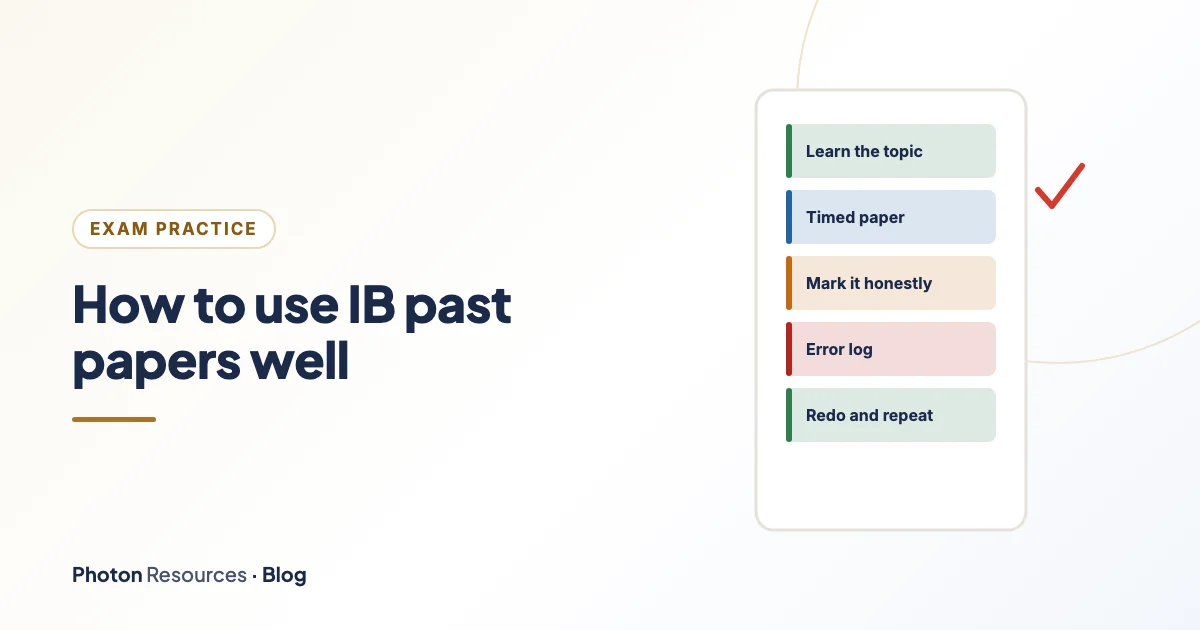
| 3. Log | 15 to 30 minutes | Record every lost mark, its cause and the fix |
| 4. Repair | As needed | Revise the weak topic, then do fresh questions on it |
| 5. Retry | One to two weeks later | Redo the logged questions from scratch |
Past papers support the rest of your plan, they do not replace it. Make sure you also keep up with your internal assessment and other coursework, using guides such as our IB maths IA guide where relevant. And check the official materials from the IB and your teacher for paper formats, as they can change between exam sessions.
Photon Resources is published by Photon Academy. The free tools above, including the IB grade calculator, are there to help you track progress as the papers pile up.
Practise it
When the papers run out, keep going
Work through original practice questions by topic and level, then check the past-paper analysis to see which topics deserve the most time.
Try the free practice questions → See the past-paper analysis →
Photon Learning Studio is on the App Store for iPhone and iPad. Get the app