
Blog
IB Chemistry notes: a revision guide by topic
Good IB Chemistry notes are not a copy of the textbook. They are a short, organised record of what you must recall, calculate and explain for each topic. This guide follows the structure of the current course, shows how to build notes for each topic, and sets out an 8 to 12 week plan with a last-two-weeks routine.
By Ejaz Ahmad · 26 October 2026 · 10 min read
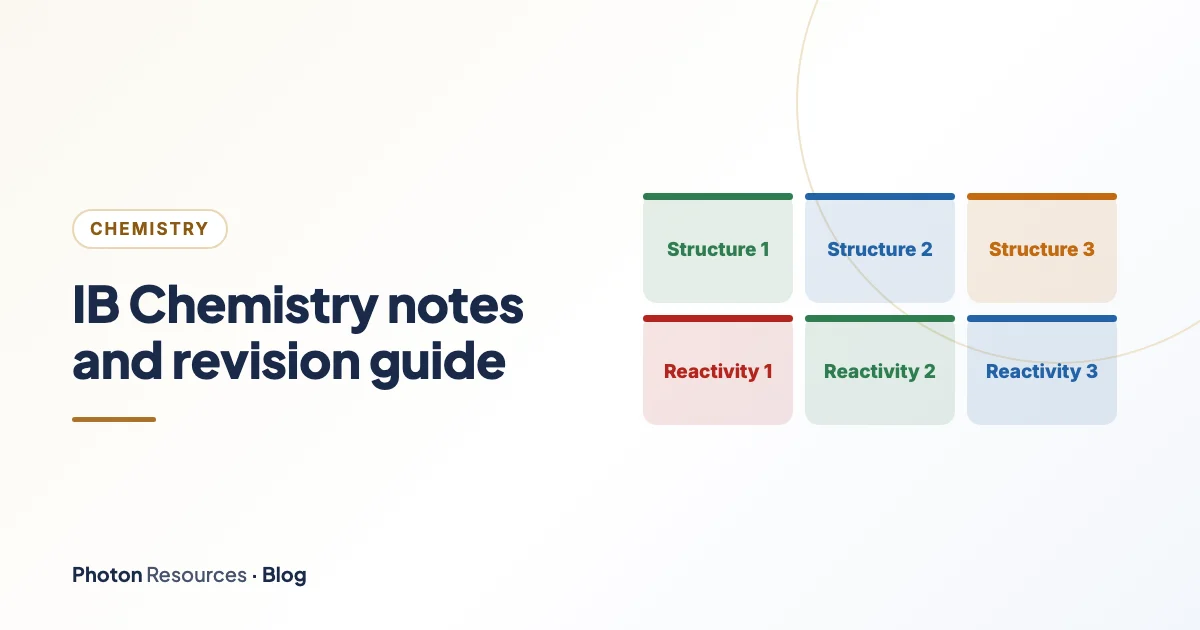
How the current IB Chemistry course is organised
The course, first assessed in 2025, is built around two strands: Structure (what matter is like) and Reactivity (how and why it changes). Each strand has three big ideas, so six in all. The titles below are as we understand them from the IB course materials, so check them against the subject guide your school gives you.
| Big idea | What your notes need to capture |
|---|---|
| Structure 1: Models of the particulate nature of matter | Atoms, the mole, gases, and the periodic table's patterns. Many later calculations start here. |
| Structure 2: Models of bonding and structure | Ionic, covalent and metallic bonding, shapes of molecules, intermolecular forces, and how bonding explains properties. |
| Structure 3: Classification of matter | Periodic trends, functional groups, naming, and the analysis of structure using data and spectra. |
| Reactivity 1: What drives chemical reactions? | Energy changes, enthalpy calculations, energy cycles and the idea of spontaneity. |
| Reactivity 2: How much, how fast and how far? | Amounts and yields, rates of reaction, and equilibrium. |
| Reactivity 3: What are the mechanisms of chemical change? | Proton transfer (acids and bases), electron transfer (redox), and the mechanisms of organic reactions. |
Higher Level (HL) adds depth within these ideas, and some content is HL only. The mark split between Paper 1, Paper 2 and the internal assessment is set out in the subject guide; the HL course page and SL course page on this site summarise what is on offer for each level. Always treat your school's guide as the authority, and browse the IB Diploma Programme page if you need the official source.
How to build IB Chemistry notes that you will actually revise from
Most students over-write notes in Year 1 and never reopen them. A better method is to give every topic the same four-part page, so you always know where to look.
- Recall boxDefinitions, trends and facts you must state from memory. Keep each to one line.
- Calculation boxEach formula you need, its units, and one fully worked example with every step shown.
- Explain boxThe reasoning chains that appear again and again, such as why a boiling point is higher or why an equilibrium shifts. Write them as "because" sentences.
- Error logThree or four mistakes you have actually made on this topic. This box is the most valuable part of the page by the final month.
Keep the page to one side of A4 if you can. If a topic runs longer, that usually means you are copying explanations instead of compressing them. Our free IB cheatsheets show what a compressed page looks like, and you can use them as a checklist against your own notes.
Structure 1 to 3: notes on particles, bonding and classification
These topics are mostly recall plus reasoning, so lean on the Recall and Explain boxes.
Structure 1: particles, the mole and gases
Build your first pages around electron configuration, isotopes and relative atomic mass, and then the mole. For gases, record the relationships between pressure, volume, temperature and amount, and when each is used. Many marks are lost not on the chemistry but on units, so write the unit next to every symbol in your notes.
Structure 2: bonding and shape
Give each type of bonding a mini-table with three columns: what particles are present, what holds them together, and what that predicts about melting point, conductivity and solubility. Then add one worked example of drawing a Lewis structure and predicting the shape and polarity. Examiners often ask you to link a property to the bonding, so practise writing the three-step chain: particles, forces, property.
Structure 3: patterns, groups and data
Treat the periodic table as a source of patterns, and write each trend with its reason (for example, nuclear charge versus shielding). For organic classification, keep one table of functional groups, with the name ending, an example, and the typical reactions. For analysis of structure, make a short page on what each technique tells you, and use the data booklet's tables rather than memorising values.
Reactivity 1 to 3: notes on energy, extent, rate and mechanisms
These topics are heavier on calculation and on multi-step explanation, so lean on the Calculation box and the Error log.
- Reactivity 1 (energetics). Write a decision list for energy questions: is it a calorimetry calculation, a bond-enthalpy estimate, or an energy-cycle problem? Practise choosing the method before you start. Always give the sign and the unit of an enthalpy change.
- Reactivity 2 (amount, rate and equilibrium). Use one page for each of three questions: how much product (stoichiometry and yield), how fast (collision theory and rate data), and how far (equilibrium and the effect of changing conditions). Keep the explanations of each factor separate in your notes, because a rate argument and an equilibrium argument are not the same thing.
- Reactivity 3 (mechanisms). Sort the content into proton transfer, electron transfer and organic mechanisms. For redox, keep a method for balancing half-equations. For organic reactions, draw each mechanism on its own card, with curly arrows starting at a lone pair or a bond and ending at an atom or a new bond.
If you are an HL student, add an extra block at the foot of each page for HL-only material, so you can see at a glance what an SL friend can skip.
Quantitative skills: why the mole decides so many marks
Almost every Reactivity topic uses the mole, so treat it as a skill to rehearse, not a topic to revise once. A reliable routine for any calculation question is the same each time.
- Write the balanced equationThe mole ratio comes from the coefficients, not from the masses.
- Convert the data to molesUse mass over molar mass, concentration times volume, or a gas relationship, whichever suits the data given.
- Find the limiting reagentCompare moles using the ratio. The one that runs out sets the answer.
- Convert back to the unit askedThen check significant figures and the unit before moving on.
Work a few of these every week until the sequence is automatic. When a question has several parts, write the unit on every line, because a missing unit or a wrong number of significant figures can cost a mark even when the method is right. The marking conventions for how errors carry through a calculation are explained in the subject materials your teacher has, and the command terms guide shows what a "calculate" or "determine" answer should look like.
How to practise equations and organic mechanisms
Equations and mechanisms are skills of the hand, not the eye. Reading a mechanism and remembering it are different from drawing it cold, so practise on blank paper.
- Balance, then add state symbols. Do five equations a session: combustion, neutralisation, precipitation, redox and one organic. Check charge as well as atoms in any ionic equation.
- Draw mechanisms from a blank page. Put the mechanism name on the front of a card and draw it from memory on the back. Check each curly arrow's start and end point, and show lone pairs and charges where they matter.
- Write the conditions. A reaction without its reagent and conditions is incomplete. Add them to every card.
- Use reaction pathways. Build one map linking each functional group you have studied to the others, with the reagent on each arrow. It doubles as a revision sheet for synthesis questions.
Using the data booklet properly
The IB gives you a data booklet in the exam, so you do not need to memorise constants or most formulas, but you do need to know what is in it and how to find it fast. Spend one session getting familiar with its layout. Our page on the IB Chemistry data booklet explains where to look, and which items students most often forget they are given.
From then on, practise with the booklet open, as you will in the exam. Note beside each topic in your notes which section of the booklet it uses, for instance the table you need for an energy calculation or for interpreting a spectrum. That small habit saves minutes per paper, and it stops you wasting memory on values you will be given anyway.
Command terms: write the answer the question asks for
Chemistry questions are decided by their first word. "State" wants a fact, "explain" wants a reasoned chain, "determine" wants a calculation with working, and "suggest" wants a sensible idea tied to the context. Read our guide to IB command terms and tag the terms in your Explain boxes, so each reasoning chain is paired with the verb that triggers it.
The exact wording of the terms is in the IB subject guide, so use it for the official definitions. For how the papers use them, read our guide to Paper 1A, Paper 1B and Paper 2 in IB Chemistry.
Practice questions and past-paper analysis
Notes build recognition, but only questions build recall under pressure. Aim for a rhythm of learn, then test within a week, then test again after a month.
- Topic practice. Use our free practice questions, which are labelled by difficulty, to move from Core level to Exam level and then Challenge.
- Past-paper analysis. Our analysis of how the papers are weighted shows which topics earn the most marks, so you can spend time where it pays. See the HL past-paper analysis or the SL past-paper analysis.
- The e-book. If you want worked explanations in book form, the Photon Chemistry guidebook covers the course with original questions and solutions.
- Mark your own work. Use your teacher's mark scheme and tick method points, not only final answers. Then add each lost mark to your Error log.
An 8 to 12 week IB Chemistry revision plan
Shorter than eight weeks is a squeeze, and longer than twelve usually drifts. Use the version that matches the time you have, and adjust it with your teacher. The table assumes about four to six hours of chemistry a week.
| Weeks | Focus | What to produce |
|---|---|---|
| 1 to 2 | Audit and set up | A topic checklist rated red, amber, green. Four-part note pages started for the weakest topics. |
| 3 to 4 | Structure 1 to 3 | Finished note pages and a set of timed questions on each. |
| 5 to 6 | Reactivity 1 and 2 | Calculation routines practised until fast. Rate and equilibrium explanations written out. |
| 7 to 8 | Reactivity 3 and organic | Mechanism cards, a reaction pathway map, and redox practice. |
| 9 to 10 | Mixed papers | Two or three full timed papers, each followed by a marking and Error-log session. |
| 11 to 12 | Targeted repair | Fix the weakest red topics, then repeat the topics you scored best on once to keep them fresh. |
With eight weeks, merge weeks 1 to 2 into one, and merge two pairs of the middle blocks. Keep the mixed-paper weeks whatever else you cut. They are where revision turns into exam performance. Our revision plan by level gives a general weekly rhythm to build around this.
The last two weeks before IB Chemistry exams
The final fortnight is for consolidation, not for learning large new blocks of content.
- Days 14 to 8. Do one timed paper under exam conditions, mark it carefully, and rework every lost mark. Use the booklet throughout.
- Days 7 to 3. Reread your Error logs and cheatsheets daily. Redraw ten mechanisms and rebalance ten equations from a blank page.
- Last two days. Light recall only, then rest. Check your calculator, your equipment and the paper timetable.
- Know your target. Use the IB grade calculator to see which paper marks you need, and check how IB grade boundaries have moved, remembering that they change each session. Our note on how grade boundaries work explains why.
Keep your internal assessment in view too, since it counts alongside the papers. Our IB Chemistry IA guide covers it, and the IUPAC website is the reference for chemical naming conventions if you want to check a name.
If you would like in-person teaching alongside self-study, Photon Academy publishes these resources.
Practise it
Turn your notes into marks
Photon practice questions are labelled by level, so you can move from Core to Exam level and Challenge as your notes firm up. Two topics in every course are free.
Photon Learning Studio is on the App Store for iPhone and iPad. Get the app